
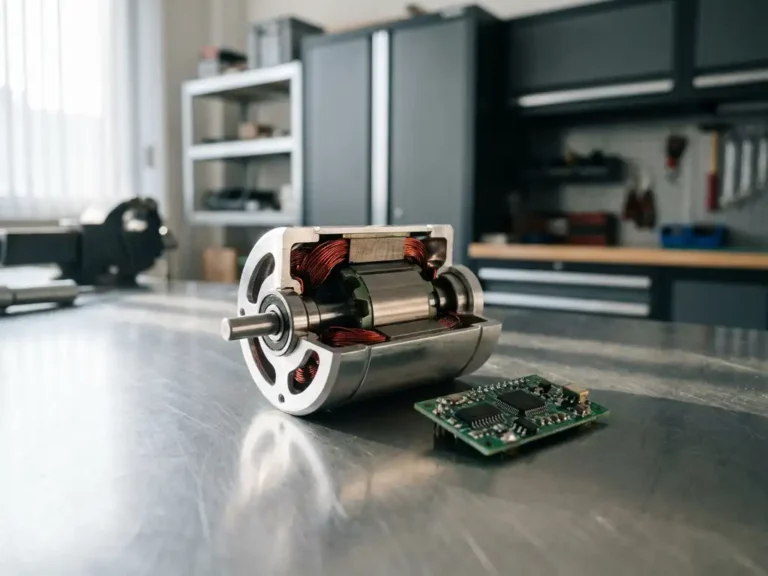
Most motor controllers rely on physical sensors to track rotor position. Encoders, resolvers, and Hall effect sensors feed real-time position data back to the controller, which uses that information to time current delivery precisely. That approach works well in controlled environments, but sensors add cost, wiring complexity, and potential failure points. Sensorless motor control removes those sensors entirely, relying instead on the motor’s own electrical signals to infer what the rotor is doing. For field engineers working across demanding applications, understanding how this works and where it fits is increasingly relevant as motor controller technology continues to evolve.
How sensorless motor control works
Without physical sensors, a sensorless controller must reconstruct rotor position from the motor’s electrical behavior. As the rotor turns, it generates back-electromotive force (back-EMF), a voltage that varies predictably with rotor speed and position. The controller samples this signal continuously and uses algorithms, typically based on observer models or flux estimation, to calculate where the rotor is and how fast it is moving.
At higher speeds, back-EMF is strong enough to give a clear, reliable signal. At low speeds or standstill, the signal becomes weak and harder to interpret, which is why many sensorless implementations use a different strategy during startup, sometimes injecting a high-frequency test signal to detect rotor position through magnetic saliency. Once the motor reaches a threshold speed, the controller transitions to back-EMF tracking. The transition must be managed carefully to avoid torque disturbances.
Sensor-based vs. sensorless control: key differences
The practical distinction between these two approaches comes down to where position information originates. Sensor-based systems receive direct, continuous feedback from hardware mounted on the motor shaft. Sensorless systems derive equivalent information from electrical measurements taken at the controller’s terminals.
Sensor-based control generally offers better low-speed torque accuracy and more predictable startup behavior, particularly under load. It is the standard choice for traction applications where precise, repeatable control from rest is non-negotiable. Sensorless control, by contrast, reduces hardware count and simplifies motor integration. It eliminates sensor wiring, removes a category of mechanical failure, and makes it easier to swap motors without recalibrating sensor alignment. The tradeoff is that the controller’s estimation algorithms must be well-tuned to the specific motor characteristics to perform reliably across the full operating range.
Performance benefits for EV and industrial applications
In applications where the motor operates primarily at moderate to high speeds, sensorless control can deliver clean, efficient performance with fewer components in the system. Pump motors, fan drives, and auxiliary systems in electric vehicles are common examples where sensorless operation is both practical and effective.
The absence of sensor cabling also matters in harsh environments. Industrial platforms such as forklifts, stackers, and boom lifts operate in conditions where connectors corrode, cables chafe, and vibration degrades sensor signals over time. Removing that hardware reduces the number of components that can degrade. For AC induction motors in particular, sensorless vector control has matured considerably, and modern controllers can achieve smooth torque response across a wide speed range without any physical feedback device.
There is also a commissioning advantage. When a controller supports automated motor tuning alongside sensorless operation, the setup process becomes significantly faster. The controller characterizes the motor electrically during an autotuning sequence, builds an internal model, and uses that model to drive the motor accurately without requiring the installer to align or configure sensors manually.
Limitations and practical considerations
Sensorless control has clear constraints that engineers need to account for before specifying it. Low-speed torque control is the most consistent limitation. Back-EMF-based estimation loses accuracy as speed approaches zero, and holding a load at standstill or producing high torque from rest requires either a startup strategy that accepts some uncertainty or a hybrid approach that blends estimation methods.
Motor parameter accuracy matters significantly. The observer algorithms that reconstruct rotor position depend on stator resistance, inductance, and other motor characteristics. If those values drift due to temperature changes or motor aging, estimation accuracy can degrade. Regular autotuning or parameter verification helps, but it is something to factor into maintenance planning on long-running installations.
For traction applications specifically, where a vehicle must accelerate smoothly from rest under load, the low-speed behavior of sensorless control introduces risk. A brief torque dip or position estimation error during startup can cause hesitation or instability in ways that are unacceptable in a vehicle context. This is why many manufacturers deliberately retain sensor-based control for traction, even when sensorless capability is available in the same platform.
Sensorless control in the SuperSigma2 controller range
DMC’s SuperSigma2 range supports sensorless motor control as part of its broader capability set, which covers AC induction, PMS, and IPM motor types on a single hardware platform. The controller runs on nominal battery voltages from 24V to 108V, with nominal power up to 30 kW and peak power up to 60 kW, making it applicable across a wide range of vehicle and industrial drive configurations.
Sensorless operation is available in the SuperSigma2, but DMC does not use it for traction drives. The reasoning reflects exactly the low-speed limitation described above: traction demands precise torque from standstill, and the risks of estimation error in that context outweigh the hardware savings. For pump motors, power steering, and auxiliary drives within the same platform, sensorless control remains a viable and practical option.
The SuperSigma2’s fully automated motor and sensor tuning means that whether a system uses sensors or runs sensorless, the controller characterizes the connected motor during setup and builds the parameters it needs to operate accurately. Combined with DMC’s IMS thermal management technology, which keeps power switching devices cooler through direct mounting on a metal substrate PCB, the platform is built to maintain consistent performance across the temperature ranges that field applications routinely produce.
For engineers evaluating whether sensorless control is the right choice for a specific application, the key questions are: what speed range does the motor operate in, what torque behavior is required at low speed, and how important is reducing sensor hardware in that environment. DMC’s team can work through those questions with you directly. Contact DMC to discuss your application requirements and find the right configuration for your system.
Related Articles
- How do traction, steering and hydraulic loads compete for power in a battery-powered machine?
- Is IPM the same as PMSM? Here's the real difference
- What does "OEM motor controller supplier" actually mean?
- Is vector control necessary for electric vehicle drivetrains?
- Peak vs continuous power ratings: what do they actually mean on a spec sheet?