
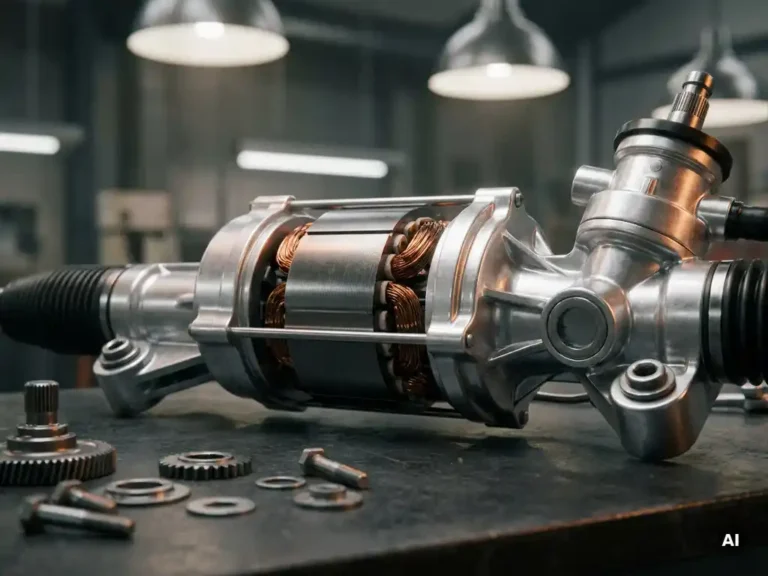
In an electric power-steering system, the electric motor generates the physical force that reduces the effort a driver needs to turn the steering wheel. It does this by applying torque directly to the steering column, rack, or pinion, depending on where the motor sits in the system architecture. The sections below work through how that assistance is triggered, how it is controlled, and what happens when something goes wrong.
How does the electric motor generate steering assistance?
The electric motor in a power-steering system generates assistance by adding torque to the steering mechanism, effectively multiplying the force the driver applies at the wheel. When the driver begins to turn, the motor activates and applies its own torque in the same direction, reducing the physical effort required to complete the turn.
Depending on the system design, the motor can be mounted at different points: on the steering column itself (column-assist EPS), on the pinion gear (pinion-assist EPS), or directly on the rack (rack-assist or dual-pinion EPS). Each mounting position changes where in the mechanical chain the assistance is introduced, but the principle is the same. The motor converts electrical energy from the vehicle battery into rotational torque, which is then transferred through gearing to the steering mechanism.
The amount of torque the motor produces is not fixed. It varies continuously based on inputs from sensors, allowing the system to deliver heavy assistance at low speeds and reduce it progressively as vehicle speed increases.
What signals tell the motor when and how much to assist?
The motor receives its instructions from a dedicated electronic control unit (ECU) that processes signals from at least two primary sensors: a torque sensor on the steering column and a vehicle speed sensor. The torque sensor detects how hard the driver is turning, and the speed sensor tells the system how fast the vehicle is moving. Together, these inputs determine both whether to assist and how much torque the motor should produce.
At low speeds, such as during parking or slow manoeuvring, the ECU commands high motor torque because the driver needs the most help. At higher speeds, the ECU reduces motor output to preserve steering feel and prevent the wheel from feeling unnaturally light. Some systems also incorporate a steering angle sensor and, in more advanced platforms, data from the vehicle’s stability control system to further refine the assistance curve.
The ECU translates these inputs into a torque demand signal, which it sends to the motor controller. The controller then regulates current through the motor windings to produce the precise torque level requested.
What types of motors are used in electric power-steering systems?
Most modern electric power-steering systems use either a brushless DC (BLDC) motor or a permanent magnet synchronous motor (PMSM). These motor types are favoured because they offer high torque density, precise controllability, and long service life without the maintenance burden of brushed designs.
Brushless DC motors were among the first to be widely adopted in EPS applications because they are compact and respond quickly to control signals. Permanent magnet synchronous motors have become increasingly common in newer designs because they offer smoother torque output and higher efficiency across a wider operating range. In industrial and off-highway vehicles, where packaging and voltage requirements differ from passenger cars, AC induction motors appear in some EPS configurations, though they are less common in this application than in traction systems.
The choice of motor type affects how the controller must manage current and commutation, which is why EPS motor controllers are designed to match the specific motor technology in the system.
How does the motor controller regulate torque output in EPS?
The motor controller regulates torque in an EPS system by precisely controlling the current flowing through the motor windings. Torque in an electric motor is directly proportional to current, so the controller uses pulse-width modulation (PWM) to vary the effective voltage applied to the motor, which in turn controls current and therefore torque output.
For permanent magnet motors, the controller typically implements field-oriented control (FOC), a technique that separates the current into torque-producing and flux-producing components. This allows the controller to command torque with high precision and fast response, which is essential in a steering application where the driver’s input can change rapidly.
Feedback from motor position sensors or, in sensorless implementations, from back-EMF estimation allows the controller to maintain accurate commutation and prevent torque ripple. Torque ripple is particularly undesirable in steering because even small irregularities in motor output can be felt through the steering wheel as vibration or roughness. Suppressing it requires tight closed-loop control and careful tuning of the controller parameters.
What happens to steering feel when the EPS motor fails?
When the EPS motor fails or loses power, the steering system reverts to manual operation. The driver can still steer the vehicle, but without any assistance, the physical effort required increases significantly, particularly at low speeds or when stationary. On larger or heavier vehicles, this can make steering genuinely difficult.
Most EPS systems are designed with mechanical continuity as a safety requirement: the steering column and rack remain mechanically connected to the wheels at all times, so a motor failure does not cause a loss of steering control, only a loss of assistance. The ECU in most systems will also illuminate a warning indicator to alert the driver that the EPS is inactive.
In vehicles where the EPS motor is integrated tightly with the steering rack, a seized or locked motor can introduce additional resistance beyond simple manual steering. This is one reason why EPS system designs include provisions for the motor to freewheel or disengage mechanically in a fault condition.
How is an EPS motor different from a traction motor on the same vehicle?
An EPS motor and a traction motor serve fundamentally different roles and are engineered to different specifications. The traction motor propels the vehicle and must handle sustained high power, often for extended periods. The EPS motor provides short bursts of assistive torque to the steering mechanism and operates at much lower continuous power levels.
In a typical industrial electric vehicle such as a forklift or AGV, the traction motor may run at tens of kilowatts continuously, while the power-steering motor operates at a fraction of that, often in the range of a few hundred watts to low kilowatts, with peak demand occurring only during turns. The duty cycle is also very different: the traction motor runs almost continuously during operation, whereas the EPS motor is active only when the driver is actively steering.
The control strategies also differ. Traction motor controllers manage speed, acceleration, and regenerative braking across a wide operating envelope. EPS motor controllers are optimised for fast torque response and smooth output within a narrow, well-defined operating range. Because of these differences, the two systems use separate controllers even when the motors are of the same type, and they are tuned independently to suit their respective tasks.
How the SuperSigma2 supports power-steering motor control
For OEM engineers integrating motor control into platforms that include a dedicated power-steering axis, the SuperSigma2 controller range from Digital Motor Control offers a capable and flexible foundation. While the SuperSigma2 is primarily deployed for traction, pump, and steering applications across industrial vehicles, its architecture is well suited to the precise torque control that EPS applications demand:
- Support for AC induction, PMS, and IPM motor types in a single controller platform, covering the motor technologies most commonly found in industrial EPS designs
- Fully automated motor and sensor tuning, which reduces commissioning time and removes the need for manual parameter identification when integrating a new motor
- Dual-processor architecture with full CANopen communication for tight integration with vehicle ECUs and supervisory control systems
- Proprietary IMS (Insulated Metal Substrate) thermal management, which keeps power switching devices cooler under cyclic loading conditions typical of steering duty cycles
- Operating voltage range from 24 V to 108 V, covering the battery architectures used across AGVs, forklifts, stackers, and other industrial platforms
If you are specifying a motor controller for a power-steering axis on a battery-driven industrial vehicle, contact the DMC team to discuss your application requirements and find the right configuration for your platform.
Related Articles
- Why do battery-powered machines use electric steering systems?
- What causes current spikes in electrically driven hydraulic systems?
- Brushless vs brushed motor controllers: what's the real difference?
- What factors affect motor selection for forklifts and warehouse equipment?
- When should you not use sensorless control?