
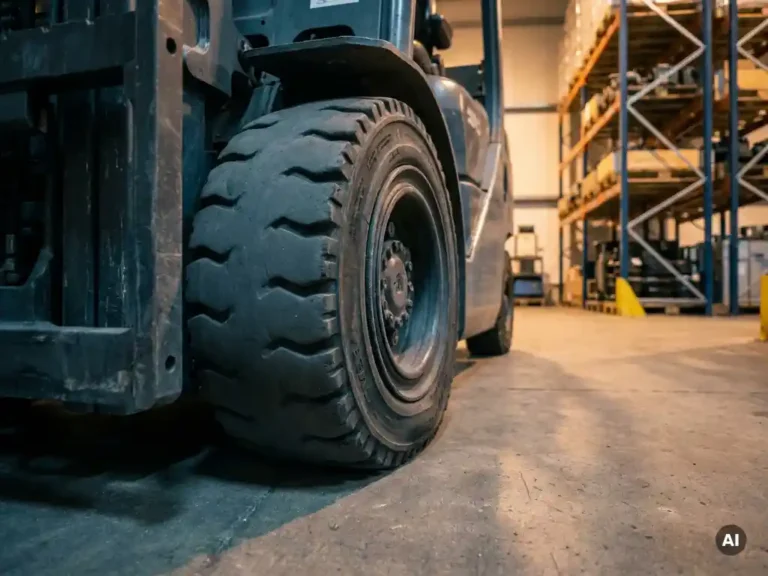
Steering demands high torque at low speed because the tires are moving slowly or not at all, which means there is no hydrodynamic lift between the rubber and the road surface. The full weight of the vehicle presses the tire contact patch flat against the ground, and the steering system must overcome the static friction of that entire patch before any rotation begins. The sections below unpack the physics, the design implications, and how engineers account for this when selecting steering motors and controllers.
What physical forces make steering so demanding at low speed?
At low speed, steering is demanding because the system must overcome static friction rather than dynamic friction. Static friction is always higher than rolling or sliding friction, and at near-zero speed the tire is essentially pivoting in place rather than rolling through a turn. The combination of vehicle weight, tire compound, and surface texture all amplify the resistive torque that the steering motor must overcome.
When a vehicle moves at speed, the tire rolls continuously and the contact patch transitions through friction states quickly, which distributes the load over time. At standstill, the entire contact patch must be twisted simultaneously. The steering motor sees a concentrated torque spike rather than a gradual load, and the peak demand can be several times higher than the steady-state steering effort at normal operating speeds.
Surface conditions matter significantly here. Dry concrete, for example, produces far higher friction coefficients than wet asphalt or packed gravel. Engineers designing electric power steering systems for warehouse vehicles or outdoor platforms must account for the worst-case surface the machine will realistically encounter.
How does tire contact patch size affect steering torque demand?
A larger tire contact patch directly increases steering torque demand because more rubber surface area is in contact with the ground, creating a greater total friction force that the steering system must overcome. Wider tires, heavier vehicles, and softer tire compounds all increase contact patch area and therefore raise the peak steering torque requirement.
The contact patch is not a fixed shape. It changes with load, inflation pressure, and tire construction. A heavily loaded forklift or boom lift with soft industrial tires will present a much larger and more compliant contact patch than a lightly loaded AGV on hard pneumatic tires. This is why steering torque specifications cannot be copied between vehicle platforms without revisiting the underlying assumptions about tire geometry and load distribution.
For OEM engineers, this means the steering torque budget must be calculated per platform, not assumed from a similar vehicle class. The contact patch area, combined with the coefficient of friction for the target surface, gives a reasonable baseline for the peak torque the steering motor must deliver.
Why is steering effort highest during a stationary or near-zero turn?
Steering effort peaks at or near zero vehicle speed because static friction between the tire and the ground is at its maximum when there is no forward motion to help rotate the contact patch. Once the vehicle begins moving, even slowly, the tire starts to roll and the friction transitions from static to kinetic, which is lower and easier for the steering motor to manage.
This effect is most pronounced during a full-lock turn from a standstill, sometimes called a spin turn or zero-radius maneuver. In this condition, the driven steered wheel must twist the entire contact patch through a large angle with no assistance from vehicle momentum. The torque required is not a brief spike but a sustained demand that lasts for the duration of the maneuver.
Hydraulic power steering systems have historically handled this by providing continuous high-pressure flow regardless of demand. Electric power steering systems must deliver the same peak torque electrically, which places strict requirements on both the motor’s torque rating and the controller’s ability to supply peak current for extended periods without thermal shutdown.
What role does the steering motor and controller play in managing peak torque?
The steering motor provides the mechanical torque, and the controller determines how quickly and accurately that torque is delivered. During low-speed steering events, the controller must respond to a torque demand that rises steeply and may need to be sustained, so both the current delivery capability and the thermal management of the controller are directly relevant to steering performance.
A motor controller for a steering application must handle a high ratio between peak torque and continuous torque. The continuous load during normal driving may be modest, but the peak demand at low speed can be three to five times higher. A controller that is sized only for the average load will current-limit or thermally protect itself precisely when the operator needs full steering authority.
The controller’s response speed also matters. Steering feel and safety depend on the system reacting within milliseconds to changes in demanded torque. Controllers with slow current loop response or coarse PWM resolution will produce noticeable lag or torque ripple, which degrades both operator comfort and vehicle control at low speed.
How do engineers size a steering motor for low-speed torque requirements?
Engineers size a steering motor by first calculating the worst-case torque at the steered wheel, then working backwards through the gear ratio to determine the motor torque required, and finally selecting a motor whose continuous and peak ratings cover both the sustained load and the transient demand with adequate margin.
The calculation starts with the tire contact patch friction torque, which depends on the vertical load on the steered axle, the tire contact patch geometry, and the friction coefficient of the target surface. This gives the torque at the steering kingpin. Dividing by the steering gear ratio gives the required motor output torque.
Peak torque at zero speed is the governing condition, not the average torque during normal driving. Engineers typically add a safety margin above the calculated peak to account for surface variation, tire aging, and load tolerance. The motor’s thermal rating at low speed is also checked separately, because at very low shaft speeds, cooling from rotor rotation is minimal and the motor must dissipate heat through its housing and mounting interface alone.
What happens if the steering controller is undersized for peak torque?
If the steering controller is undersized for peak torque, it will current-limit or trigger thermal protection at the moment of maximum steering demand, which is precisely the condition where full torque is needed. The result is reduced steering authority at low speed, which can manifest as heavy or unresponsive steering, incomplete lock-to-lock travel, or a complete loss of power assist during critical maneuvers.
In industrial vehicles such as forklifts or order pickers, this failure mode has direct safety implications. An operator attempting to navigate a tight aisle or position a load precisely depends on consistent steering response. A controller that intermittently limits output creates unpredictable behavior that increases the risk of collision or load drop.
Thermal undersizing is a common root cause. A controller may handle brief peak torque events but fail during repeated or sustained low-speed maneuvering, such as a vehicle repeatedly repositioning in a loading bay. The controller heats progressively and reduces its current limit to protect itself, degrading performance gradually rather than failing abruptly, which makes the problem harder to diagnose in the field.
How the SuperSigma2 addresses steering torque demands
The SuperSigma2 from DMC is designed to handle exactly the kind of high peak-to-continuous torque ratio that steering applications impose. Several of its design characteristics are directly relevant to low-speed steering performance:
- Peak power output up to 60 kW against a 30 kW continuous rating gives the controller headroom to deliver sustained peak current during prolonged low-speed maneuvers without immediate thermal limiting.
- DMC’s proprietary IMS (Insulated Metal Substrate) technology mounts power switching devices directly onto a metal PCB, which removes the thermal bottleneck that typically forces conservative current derating in conventional designs. This keeps the switching devices cooler during the sustained high-current events that low-speed steering demands.
- Fully automatic motor and sensor tuning means the controller accurately characterizes the steering motor’s electrical parameters before deployment, so current loop response is optimized for that specific motor rather than relying on generic defaults that introduce lag or overshoot.
- Compatibility with AC induction, PMS, and IPM motor types gives OEM engineers flexibility to select the motor topology best suited to the steering torque profile of their platform.
- Operating voltage from 24 V to 108 V covers the range of battery systems used across AGVs, forklifts, and industrial platforms where steering torque at low speed is a design constraint.
If you are specifying a steering controller for a platform where low-speed torque is a concern, the SuperSigma2 controller range is worth evaluating against your peak torque and thermal requirements. To discuss your specific application, contact the DMC engineering team directly.
Related Articles
- AC, PMS, or series-wound: which motor type should you select?
- BLDC vs PMSM controllers: are they the same thing?
- What is J1939 and how does it differ from CANopen for motor controllers?
- Do you need a bigger motor or a smarter controller? How to decide
- What is the difference between a motor controller and a motor inverter?