
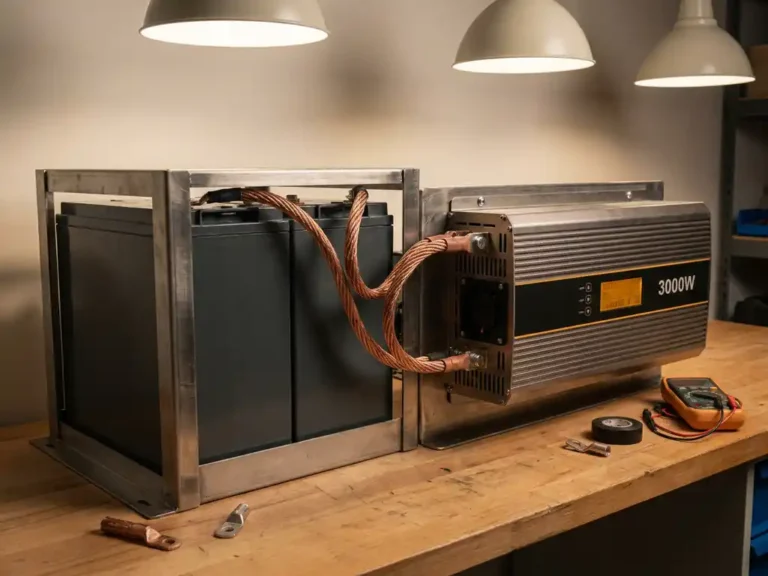
To run a 3000W inverter, you typically need a battery bank with at least 250 to 300 amp-hours (Ah) of usable capacity at 12V for a one-hour runtime at full load, or proportionally less capacity at higher voltages (roughly 125 to 150Ah at 24V and 62 to 75Ah at 48V). The exact size depends on how long you need the inverter to run, your battery chemistry, and the actual load connected to the inverter. The sections below break down each of these factors so you can size your battery bank accurately.
How to Calculate Battery Size for a 3000W Inverter Step by Step
To calculate battery size for a 3000W inverter, convert the load to battery-side watts using inverter efficiency, divide by system voltage to get amps, multiply by runtime in hours, and then divide by the battery’s usable depth of discharge. Think of your battery as a fuel tank and the amps as the flow rate at which the inverter drains it. The memory rule is Ah x V = Wh: amp-hours multiplied by volts gives you watt-hours of stored energy. To size a bank, work through these five steps:
- Determine the load in watts (up to 3000W for a fully loaded inverter).
- Divide by the inverter efficiency (typically 0.85 to 0.90) to find the real power drawn from the battery.
- Divide by the system voltage (12V, 24V or 48V) to get the DC current in amps.
- Multiply by the desired runtime in hours to get the required amp-hours.
- Divide by the usable depth of discharge (DoD, the share of a battery’s rated capacity you can safely use) of your battery chemistry to get the nominal capacity you need to buy.
Here is a worked example for a 3000W load running for 1 hour on a 12V system, using 85% inverter efficiency:
- 3000W / 0.85 = about 3529W drawn from the battery
- 3529W / 12V = about 294A DC current
- 294A x 1 hour = about 294Ah
- LiFePO4 (lithium iron phosphate, 80% usable): 294Ah / 0.8 = about 368Ah nominal
- AGM (absorbent glass mat lead-acid, 50% usable): 294Ah / 0.5 = about 588Ah nominal
The 294Ah result in step 4 matches the 250 to 300Ah rule of thumb above, which is the usable capacity for one hour at 12V. The nominal capacity you actually buy is higher once you account for depth of discharge, which is why chemistry matters so much for the final number.
Battery Size Chart for a 3000W Inverter at 12V, 24V and 48V
Higher system voltage means proportionally lower current and lower capacity requirements in Ah. The table below shows the DC current at full 3000W load and the amp-hours needed for 30 minutes, 1 hour and 2 hours of runtime on a 3000W inverter.
| System voltage | DC current at 3000W | Ah for 30 min | Ah for 1 hour | Ah for 2 hours | Typical cable and fuse class |
|---|---|---|---|---|---|
| 12V | about 290 to 300A | about 145 to 150Ah | about 290 to 300Ah | about 580 to 600Ah | Very heavy cable, 300A-class fuse or breaker |
| 24V | about 145 to 150A | about 72 to 75Ah | about 145 to 150Ah | about 290 to 300Ah | Heavy cable, 150A to 200A-class fuse |
| 48V (51.2V nominal for LiFePO4) | about 72 to 75A | about 36 to 38Ah | about 72 to 75Ah | about 145 to 150Ah | Moderate cable, 80A to 100A-class fuse |
Values assume 85 to 90 percent inverter efficiency and show usable capacity before depth-of-discharge adjustments. For the capacity you actually need to buy, divide the result by the usable DoD of your chemistry (see the comparison below). Always confirm cable and fuse sizes against the cable manufacturer’s ampacity chart and your inverter manual.
How long do you need the 3000W inverter to run?
Runtime is the single most important variable when sizing a battery for a 3000W inverter, because battery capacity scales linearly with it: doubling the required runtime doubles the required amp-hours. Before calculating anything else, decide how many hours of continuous operation you need. A system designed for 30 minutes of use needs a fraction of the capacity required for a four-hour application.
Think in terms of your actual use case. A backup power system that runs a sump pump for short bursts has very different requirements from an off-grid worksite setup powering tools through a full shift. Write down your expected runtime in hours, because that number feeds directly into every calculation that follows.
Need a controller for your application?
From traction to pump control, ask us about the right solution for your requirements.
How do you calculate the amp-hours needed for a 3000W inverter?
To calculate the amp-hours needed, divide the inverter’s wattage by the battery bank voltage to get the current draw in amps, then multiply by the number of hours you need to run it. For a 3000W inverter on a 12V system, that is 3000 divided by 12, which equals 250 amps in theory. For two hours of runtime, you need 500Ah before accounting for inefficiency losses.
The formula looks like this:
- Amps = Watts divided by Volts (3000W / 12V = 250A)
- Raw Ah needed = Amps multiplied by Hours (250A x 2 hours = 500Ah)
- Adjusted Ah = Raw Ah divided by inverter efficiency (typically 0.85 to 0.90, which raises 500Ah to roughly 555 to 590Ah)
- Nominal capacity to buy = Adjusted Ah divided by maximum depth of discharge for your battery type
Working through those steps gives you a realistic capacity target rather than a theoretical minimum. Skipping the efficiency and depth-of-discharge adjustments is one of the most common reasons battery banks underperform in the field.
What battery voltage works best with a 3000W inverter?
Higher battery voltages work better with a 3000W inverter because they reduce the current draw significantly. A 3000W load draws about 250 amps from a 12V bank, 125 amps from a 24V bank, and only about 62.5 amps from a 48V bank, before inverter efficiency losses (which add roughly 10 to 18 percent). Lower current means thinner, lighter cabling, smaller fuses, less heat, and reduced resistive losses throughout the system.
For a 3000W inverter, 24V is the practical minimum for anything beyond very short runtimes. A 48V system is a much better choice for sustained operation because the wiring and connection losses at 250 amps or more on a 12V system become a real engineering problem. Most purpose-built inverter systems at this power level are designed around 24V or 48V battery banks for exactly this reason.
Does battery chemistry affect how much capacity you actually get?
Yes, battery chemistry directly affects usable capacity because different chemistries tolerate different depths of discharge. A 100Ah lead-acid battery should only be discharged to 50% to preserve cycle life, giving you 50Ah of usable capacity. A 100Ah lithium iron phosphate (LiFePO4) battery can be discharged to 80 to 90% without significant degradation, giving you 80 to 90Ah of usable capacity from the same nominal rating.
This difference has a large practical impact on battery bank sizing. To get 200Ah of usable capacity, you need 400Ah of lead-acid but only around 230Ah of LiFePO4. Lithium batteries also deliver more consistent voltage under load, which means the inverter operates more efficiently across the discharge cycle. Lead-acid voltage sags noticeably as the battery depletes, which can cause inverters to shut down before the rated capacity is fully used.
AGM (absorbent glass mat) batteries sit between flooded lead-acid and lithium in terms of depth-of-discharge tolerance. Manufacturers often quote 50 to 70%, though 50% is the safer planning figure for long cycle life, and AGM handles high discharge rates better than standard flooded cells.
LiFePO4 vs Lead-Acid and AGM for a 3000W Inverter
For a 3000W inverter, LiFePO4 delivers the most usable capacity per nominal amp-hour, while AGM and flooded lead-acid are cheaper upfront but need roughly double the nominal capacity. Nominal Ah is not usable Ah, and this is where many buyers under- or over-size their bank. The table below compares the three common chemistries using general ranges. Exact figures vary by manufacturer and model.
| Criterion | LiFePO4 | AGM | Flooded lead-acid |
|---|---|---|---|
| Usable depth of discharge | about 80 to 100% | about 50% | about 50% |
| Typical cycle life | Several thousand cycles | Several hundred cycles | A few hundred cycles |
| Weight | Lowest | High | Highest |
| High-current discharge | Stable voltage under heavy load | Good, but voltage sags | Weakest, strong voltage sag |
| Upfront cost | Highest | Medium | Lowest |
| Cost per usable kWh over lifetime | Usually lowest with frequent cycling | Medium | Often highest when cycled daily |
A practical example: a 300Ah nominal AGM bank gives you roughly 150Ah usable, while a 300Ah LiFePO4 bank gives you roughly 240 to 300Ah usable. At 3000W, lead-acid also suffers from the Peukert effect, which means its effective capacity drops further when it is discharged at high currents.
For daily off-grid use, LiFePO4 is usually the better choice because of its usable capacity, cycle life and lower weight. For rare backup use where the bank sits idle most of the time, AGM can be a reasonable budget option, provided you size it with the 50% depth-of-discharge limit in mind.
Why does a 3000W inverter draw more power than the connected load?
A 3000W inverter draws more power from the battery than the load consumes because the inverter itself is not perfectly efficient. No power conversion is lossless. Typical inverter efficiency ranges from 85% to 92%, meaning that for every 100W delivered to your load, the battery supplies about 109 to 118W. At full 3000W output, the battery may be supplying roughly 3260 to 3530W.
There are two sources of this additional draw. The first is conversion loss, the heat generated as the inverter transforms DC battery power into AC output. The second is the inverter’s own standby consumption (also called idle or self-consumption), which runs continuously as long as the inverter is switched on, even if no load is connected. On a large inverter, standby draw can range from 15W to over 50W depending on the design.
Always use the inverter’s efficiency rating when sizing your battery bank. Using the nominal output wattage without an efficiency correction will leave you short of runtime.
What size battery bank is typically recommended for a 3000W inverter?
For a 3000W inverter running at or near full load for one hour, a common recommendation is a nominal 150 to 200Ah lithium bank at 24V, or a 75 to 100Ah lithium bank at 48V. With lead-acid batteries, double those figures to account for the 50% depth-of-discharge limit. These figures include a modest buffer for inverter inefficiency and real-world load variation.
For practical planning, consider these typical scenarios at full 3000W load unless stated otherwise:
- 30-minute runtime on 24V lithium: approximately 90 to 100Ah nominal
- 1-hour runtime on 24V lithium: approximately 180 to 200Ah nominal
- 2-hour runtime on 24V lithium: approximately 360 to 400Ah nominal
- 2-hour runtime on 24V lead-acid: approximately 600 to 800Ah nominal
- 4-hour runtime at half load (1500W) on 48V lithium: approximately 75 to 100Ah nominal
Most real-world loads do not run at the inverter’s maximum rated wattage continuously. If your actual connected load averages 1500W rather than 3000W, your battery requirement drops proportionally. Sizing for average load rather than peak load is a reasonable approach for most applications, provided the battery and inverter can handle the peak draw during startup surges.
Cable Size, Fuses and Safety for High-Current 12V Systems
A 3000W load on a 12V system draws roughly 250A to 300A, and that current creates real fire risk if the system is not built correctly. It requires thick cables, a correctly rated main fuse or DC breaker, short cable runs, and a battery or BMS (battery management system, the electronics that protect a lithium battery) rated for that continuous discharge current. At 24V the current halves, and at 48V it drops to roughly a quarter, which allows much thinner cables and smaller protection devices.
Check the cable manufacturer’s ampacity chart and your inverter manual to choose the correct cable cross-section for your cable length and installation conditions. Use this checklist as a starting point:
- Install a correctly rated DC fuse or breaker as close to the battery as possible.
- Keep cable runs between battery and inverter as short as possible to limit voltage drop and heat.
- Use properly crimped, correctly sized lugs and tighten all terminals to the specified torque.
- Provide ventilation around the inverter, cables and battery bank.
- Make sure the BMS continuous discharge rating is above the inverter’s maximum DC draw, including surge loads.
This guide is general information and not a substitute for the inverter manual. If you are unsure about any part of the installation, consult a qualified electrician.
Why Real-World Runtime Can Differ From the Calculation
Real runtime on a 3000W inverter can differ from the calculated value because several factors shift actual performance away from the formula:
- Inverter efficiency at partial load: efficiency is usually lower at very light loads, so small loads can drain the battery faster than the formula suggests.
- Idle self-consumption: the inverter uses power whenever it is switched on, even with no load connected.
- Peukert effect: lead-acid batteries deliver less usable capacity at high discharge currents.
- Low temperatures: cold weather reduces usable capacity, especially for lead-acid, and LiFePO4 may need charge protection below freezing.
- Battery aging: capacity declines over the years, so a bank sized exactly for today’s needs will fall short later.
- Cable losses and voltage sag: thin or long cables and heavy loads reduce the voltage at the inverter, which can trigger low-voltage shutdowns early.
To cross-check your calculation, install a battery monitor and track your actual consumption for a day, then adjust the bank size accordingly. As a general rule, add a safety margin of about 20 percent to your calculated capacity.
How DMC’s motor controllers relate to battery-powered system design
The same principles that govern inverter battery sizing apply directly to motor controller applications in electric vehicles and industrial platforms. In battery-driven systems, every component in the power chain, from battery chemistry to voltage architecture, affects how efficiently the motor controller can operate and how long the vehicle can run between charges.
DMC’s SuperSigma2 motor controllers are built around these realities. Key design features that address the challenges covered in this article include:
- Wide voltage compatibility from 24V to 108V nominal, allowing system designers to choose the battery voltage that minimizes current draw and wiring losses
- Nominal power up to 30kW and peak power up to 60kW, with efficiency optimized through IMS (Insulated Metal Substrate) thermal management that keeps switching devices cooler and reduces conversion losses
- Fully automatic motor and sensor tuning, which removes the manual calibration work that can introduce inefficiency during commissioning
- Support for AC induction, PMS (permanent magnet synchronous), and IPM (interior permanent magnet) motor types within a single platform, giving integrators flexibility without sacrificing performance
If you are specifying a battery-driven system and need guidance on matching controller voltage range to your battery architecture, contact DMC directly to discuss your application requirements.
Frequently Asked Questions About Batteries for a 3000W Inverter
What size battery do I need for a 3000W inverter?
For one hour at full load you need roughly 250 to 300Ah of usable capacity at 12V, or about half that at 24V and about a quarter at 48V. Divide that figure by the usable depth of discharge of your chemistry to get the nominal capacity to buy.
How many amps does a 3000W inverter draw at 12V?
A 3000W inverter draws roughly 250A at 12V in theory, and about 290 to 300A once inverter efficiency of 85 to 90 percent is included. This is why 12V systems at this power level need very thick cables and heavy-duty fusing.
How long will a 200Ah battery run a 3000W inverter?
A 200Ah 12V battery will run a full 3000W load for well under one hour, roughly 40 minutes at best with LiFePO4 and considerably less with lead-acid. Using the 294A example above, 200Ah of usable capacity lasts about 0.7 hours, and fewer if the usable depth of discharge is limited to 50%.
Is a 100Ah battery enough for a 3000W inverter?
A single 100Ah 12V battery is only enough for a few minutes at full load, and it may not be able to deliver the 250A to 300A current at all. A 100Ah battery makes more sense at 48V or for much smaller average loads.
Is 3000 watts the same as 3000 VA?
No, watts measure real power while VA (volt-amperes) measures apparent power, and the two are only equal for purely resistive loads. Many inverters are rated in watts, but loads with a low power factor can draw more VA than watts, so check the inverter’s continuous and surge ratings.
Can I run a 3000W inverter on a 24V or 48V battery bank?
Yes, as long as the inverter is designed for that input voltage, because inverters are built for a specific DC voltage. A 24V or 48V bank cuts the current to roughly 150A or 75A at full load, which simplifies cabling and improves efficiency.
Conclusion
Sizing a battery bank for a 3000W inverter comes down to a few steps: define the load and runtime, correct for inverter efficiency, divide by system voltage, adjust for the depth of discharge of your chemistry, and add a safety margin. Higher voltages and LiFePO4 chemistry reduce the current and the nominal capacity you need, while careful cabling and fusing keep the system safe.
Quick tip: for one hour at full load, plan for roughly 300Ah usable at 12V, 150Ah at 24V or 75Ah at 48V, then divide by your battery’s usable depth of discharge.