
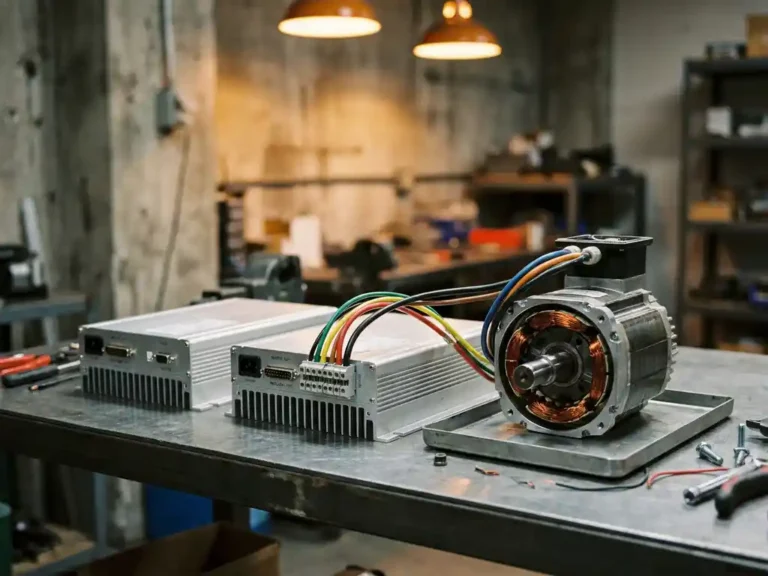
When specifying a motor controller for an electric vehicle or industrial platform, engineers frequently encounter two terms used almost interchangeably: PMSM and PMS. The question of whether a PMSM motor controller and a PMS motor controller are actually different products, or simply different labels for the same thing, comes up more often than you might expect. The short answer is that they refer to the same motor technology. The longer answer is worth understanding before selecting a controller for your application.
Permanent magnet synchronous motors have become a dominant choice across battery-powered vehicles, forklifts, AGVs, and a wide range of industrial platforms, largely because of their high efficiency and precise controllability. Getting the terminology straight matters because it affects how engineers search for, specify, and compare controllers, and confusion between naming conventions can lead to unnecessary second-guessing during procurement.
Two names, one motor type
PMSM stands for permanent magnet synchronous motor, while PMS is simply an abbreviated form of the same description. Neither term defines a distinct motor category. Both refer to AC synchronous motors that use permanent magnets embedded in or mounted on the rotor to generate the magnetic field, rather than relying on rotor windings or external excitation.
The variation in naming comes mostly from regional conventions, manufacturer preferences, and how different engineering traditions have abbreviated the same underlying concept. In some European technical contexts, PMS is the preferred shorthand. In North American and broader international documentation, PMSM is more common. When a datasheet specifies compatibility with PMS motors and another specifies PMSM motors, they are describing the same electrical machine type. A controller designed for one will operate the other without modification.
What the controller actually responds to
A permanent magnet synchronous motor controller does not respond to a name on a label. It responds to the electrical characteristics of the motor: the back-EMF waveform, the inductance profile, the resistance of the stator windings, and the rotor position feedback (or the absence of it, in sensorless configurations). These parameters are identical whether the motor documentation calls it a PMS motor or a PMSM.
What distinguishes a controller’s compatibility is its ability to implement the correct control algorithm, typically field-oriented control (FOC), and to handle the motor’s specific voltage and current requirements. A controller tuned for a PMSM will apply the same vector control mathematics regardless of which abbreviation appears in the motor’s manual. The practical implication is that when comparing controllers across suppliers, the naming convention used in the product description should not be treated as a compatibility filter.
Rotor position sensing is one area where practical differences do arise, though not because of the PMS versus PMSM distinction. Some motors use Hall-effect sensors, others use encoders or resolvers, and some applications benefit from fully sensorless operation. A capable AC motor controller should support multiple feedback configurations to remain flexible across motor variants.
How PMAC compatibility extends the picture
Beyond the PMS/PMSM naming question, there is a related term that does carry a meaningful technical distinction: PMAC, or permanent magnet AC motor. This category includes both surface-mounted permanent magnet (SPM) motors and interior permanent magnet (IPM) motors. The difference between SPM and IPM designs lies in where the magnets are positioned relative to the rotor core, which affects the motor’s inductance characteristics and the degree of reluctance torque available.
Controllers designed to handle the full PMAC family need to account for this variation. IPM motors, in particular, benefit from control strategies that exploit reluctance torque, which requires the controller to apply more sophisticated current angle optimization. SPM motors, which behave more like classical PMSM designs, are somewhat simpler to control but still require precise field-oriented control for optimal performance. A controller that claims broad PMAC compatibility should be able to handle both motor subtypes, ideally through automated tuning rather than manual parameter entry.
This is where automated motor identification becomes genuinely useful. Rather than requiring an engineer to manually input motor parameters, a controller with built-in tuning routines can measure the motor’s electrical characteristics at startup and configure itself accordingly, reducing commissioning time and the risk of misconfiguration across different motor variants.
Choosing the right controller for your application
The naming convention used in a motor’s documentation should be one of the last things influencing a controller selection decision. What matters is whether the controller can handle the motor’s voltage range, current requirements, and mechanical configuration, and whether it supports the feedback method the motor uses for rotor position sensing.
For battery-powered applications, the nominal battery voltage is a primary constraint. Controllers designed for low-voltage platforms (24V to 48V) are not interchangeable with those designed for higher-voltage systems (72V to 108V) without careful verification of switching device ratings and protection thresholds. Peak power handling is equally relevant: a motor may run at modest continuous power but require short bursts of significantly higher torque during acceleration or load handling, and the controller must be rated for both conditions.
Thermal management is another factor that deserves more attention than it typically receives during specification. Power switching devices generate heat proportional to the current they carry, and sustained high-current operation in a confined vehicle or industrial enclosure places real demands on the controller’s ability to dissipate that heat. Controllers that integrate heat sinking directly into their PCB construction, rather than relying on external heatsinks alone, tend to perform more consistently across demanding duty cycles. Explore the full DMC product range to understand how this applies in practice.
How DMC helps with permanent magnet motor control
DMC’s SuperSigma2 and Sigma2N controller ranges are designed specifically to address the real-world complexity of permanent magnet synchronous motor applications, whether the motor documentation refers to them as PMS, PMSM, or PMAC. The key capabilities that make these controllers well-suited to this application space include:
- Compatibility with AC induction, PMS, and IPM motor types within a single controller range, covering nominal battery voltages from 24V to 108V
- Fully automated motor and sensor tuning that identifies motor parameters at commissioning, eliminating manual configuration errors
- Sensorless motor control as a standard option, providing flexibility where encoder or Hall-effect feedback is unavailable or impractical
- Peak power handling up to 60kW, with continuous ratings up to 30kW, suited to demanding traction and pump applications
- Proprietary IMS (Insulated Metal Substrate) technology that mounts power switching devices directly onto a metal PCB, keeping junction temperatures lower and improving long-term reliability under sustained load
These are not incremental refinements. They reflect a design philosophy built around the operational realities of electric vehicles and industrial platforms where motor naming conventions vary but performance requirements do not. If you are specifying a controller for a permanent magnet synchronous motor application and want to discuss compatibility with your specific motor and system requirements, contact the DMC team directly.
Related Articles
- Why do battery-powered machines use electric steering systems?
- How is power distributed inside a battery-powered mobile machine?
- FOC vs traditional PWM control: what's the performance difference?
- How much more efficient is IMS cooling than a traditional heatsink?
- What is the difference between a motor controller and a motor inverter?