
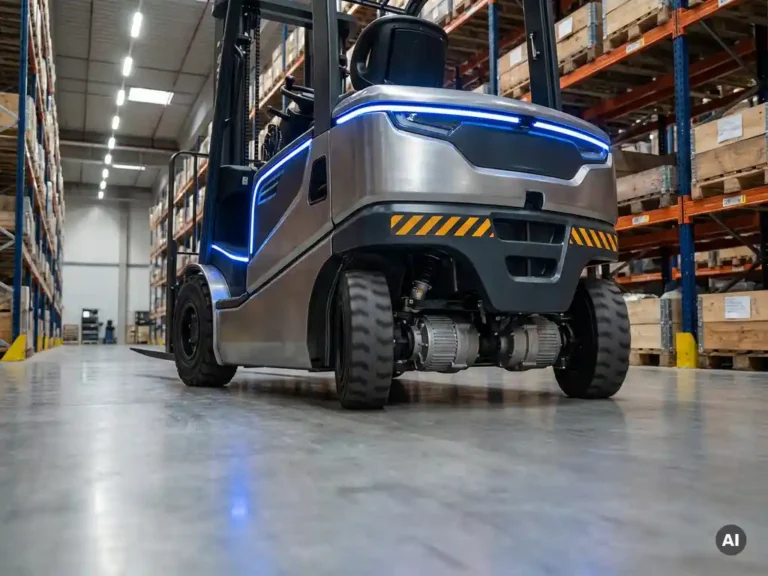
In a battery-powered vehicle, steering and traction systems interact by sharing a common power source, the battery, and, in many designs, a shared thermal and electrical budget managed by the motor controller or controllers. When traction demand rises sharply, available current for the power steering motor can drop unless the control architecture actively manages that relationship. The sections below unpack how that interaction plays out across load sharing, real-time coordination, control architecture choices, and regenerative braking.
How does load sharing work between steering and traction motors?
Load sharing between steering and traction motors in a battery-powered vehicle works by distributing available battery current across both systems according to demand, priority rules, and the thermal headroom of each controller. Neither motor draws independently of the other in a well-designed system, the control layer mediates between them to prevent total current from exceeding what the battery can safely supply.
In practice, traction typically holds higher priority. The vehicle must move, and traction loads are both larger and more variable. A forklift climbing a ramp or an AGV accelerating from rest can draw several times more current than the same vehicle traveling at steady speed. The steering motor, by contrast, draws relatively little current during straight-line travel and spikes only when the operator makes a turn at low speed or when the vehicle is maneuvering in a tight space.
The challenge arises precisely at the intersection of those two peaks: a hard turn while accelerating, or a tight maneuver under a heavy load. If the system has no mechanism to coordinate current allocation, one or both motors will see voltage sag, and the controller protecting itself from overcurrent will derate, usually the steering motor, since it has the lower priority. The operator feels this as steering that suddenly requires more effort or responds more slowly.
What causes steering performance to degrade under heavy traction loads?
Steering performance degrades under heavy traction loads primarily because of voltage sag on the battery bus. When the traction motor draws a large current surge, internal battery resistance causes the bus voltage to drop. The power steering motor controller sees a lower supply voltage, which limits the torque it can produce, and the operator experiences reduced steering assistance at exactly the moment the vehicle is hardest to maneuver.
A secondary cause is thermal derating. If the steering controller is running warm from sustained use, common in vehicles doing repeated short-radius turns, such as order pickers or reach trucks, it may reduce its own output current to protect its power devices. Combined with a voltage sag event from traction, the effect compounds quickly.
Control latency is a third factor that is often overlooked. If the two controllers are not communicating in real time, the steering controller cannot anticipate a traction surge, it can only react after the voltage has already dropped. That reaction lag, even if only tens of milliseconds, is long enough to produce a noticeable hesitation in steering response.
How do motor controllers coordinate traction and steering in real time?
Motor controllers coordinate traction and steering in real time through a shared communication bus, most commonly CAN. Each controller broadcasts its current draw, thermal state, and operating mode, and a supervisory layer, either a dedicated vehicle control unit or logic embedded in one of the controllers, uses that data to enforce system-level current limits and priority rules dynamically.
When the traction controller signals a high-demand event, such as a load pickup or a steep ramp, the supervisory layer can instruct the steering controller to operate within a tighter current envelope until the peak passes. This coordination happens in milliseconds and is invisible to the operator under normal conditions.
The quality of this coordination depends heavily on how frequently the controllers exchange data and how deterministic that exchange is. A CAN bus running at a low update rate introduces latency that makes proactive coordination difficult. Controllers designed with real-time coordination in mind run at higher update rates and implement predictive current budgeting rather than purely reactive limiting. For OEM engineers evaluating motor controllers, the communication architecture is as important a specification as peak current rating.
What’s the difference between independent and integrated steering-traction control?
Independent control means each motor has its own dedicated controller with no direct communication between them, coordination, if any, happens only through the battery bus and whatever passive load-balancing results from shared voltage. Integrated control means a single controller or a tightly coupled pair of controllers manages both motors with shared current budgeting, shared thermal monitoring, and active coordination logic.
Independent control is simpler to design and easier to source, but it produces the degradation patterns described above: voltage sag on one motor affects the other with no compensating response. It also makes system-level diagnostics harder, since neither controller has visibility into what the other is doing.
Integrated or tightly coupled control adds complexity but gives the system real leverage over both motors simultaneously. A dual-motor controller, for example, can enforce a hard system current ceiling that neither motor can exceed, regardless of individual demand spikes. This produces more predictable behavior under load and simplifies thermal management because heat dissipation is consolidated into one mechanical assembly.
How does regenerative braking affect the steering system?
Regenerative braking affects the steering system primarily by reversing the direction of current flow on the battery bus. During regen, the traction motor acts as a generator and pushes current back into the battery. If the steering controller is drawing current at the same time, the net bus behavior changes, voltage can rise slightly rather than sag, which may cause the steering controller to behave differently than it does under motoring conditions.
Most modern controllers handle this gracefully because they regulate against bus voltage rather than assuming a fixed supply. The steering controller sees a higher bus voltage during regen and simply adjusts its PWM duty cycle to maintain the commanded output torque. The operator notices nothing.
The scenario that does require careful design attention is regenerative braking combined with a simultaneous steering input at low speed. In that condition, the traction controller is managing a complex transition from motoring to generating while the steering controller is demanding peak current for a tight turn. The system-level current balance in that moment depends entirely on whether the two controllers are coordinating or acting independently.
When should an OEM use a dual-motor controller versus two separate controllers?
An OEM should use a dual-motor controller when the vehicle regularly operates both motors at high load simultaneously, when installation space is constrained, or when the system design requires tight current coordination between traction and steering. Two separate controllers are appropriate when the motors operate largely independently, when different voltage rails are needed for each motor, or when modularity and independent serviceability are higher priorities than system-level optimization.
The decision also depends on power levels. At lower power ranges, a dual-motor controller can serve both functions within a single thermal envelope, reducing component count and wiring complexity. At higher power levels, the heat generated by both motors may exceed what a single housing can dissipate without aggressive external cooling, making two separate units with independent heat paths the more practical choice.
Serviceability is a practical consideration that OEM engineers sometimes underweight at the design stage. Two separate controllers mean that a fault in the steering system does not take the traction system offline, and a field technician can swap one unit without disturbing the other. A dual-motor controller offers a single point of failure for both functions, which matters in applications where uptime is critical, such as warehouse AGVs or hospital logistics vehicles.
How the SuperSigma2 addresses steering and traction coordination
DMC’s SuperSigma2 controller range is designed specifically for the kind of multi-motor coordination that battery-powered industrial vehicles require. Key capabilities relevant to steering and traction integration include:
- Support for both AC induction and PMAC (PMS and IPM) motors within a single platform, so traction and steering motors do not need to be the same motor type to share a control architecture
- Operating range from 24 V to 108 V nominal with peak power up to 60 kW, covering the full spectrum from compact stackers to heavy forklifts and AGVs
- Full CANopen integration with a dual-processor architecture, enabling the real-time inter-controller communication that makes proactive current coordination possible
- Fully automated motor and sensor tuning, which reduces commissioning time when integrating a new steering or traction motor into an existing platform
- IMS (Insulated Metal Substrate) thermal management, which keeps power devices cooler under sustained load and reduces the thermal derating events that degrade steering response
If you are designing or re-engineering a vehicle platform and want to discuss how to structure the control architecture for your specific traction and steering requirements, contact DMC’s engineering team directly. You can also review the full product range to identify the right controller configuration for your application.
Related Articles
- How does electric power steering work in industrial vehicles?
- How does a changing payload affect an electric drivetrain?
- What is a brushless motor controller, and how does it work?
- Do you need a bigger motor or a smarter controller? How to decide
- How does a traction controller differ from a general motor controller?