
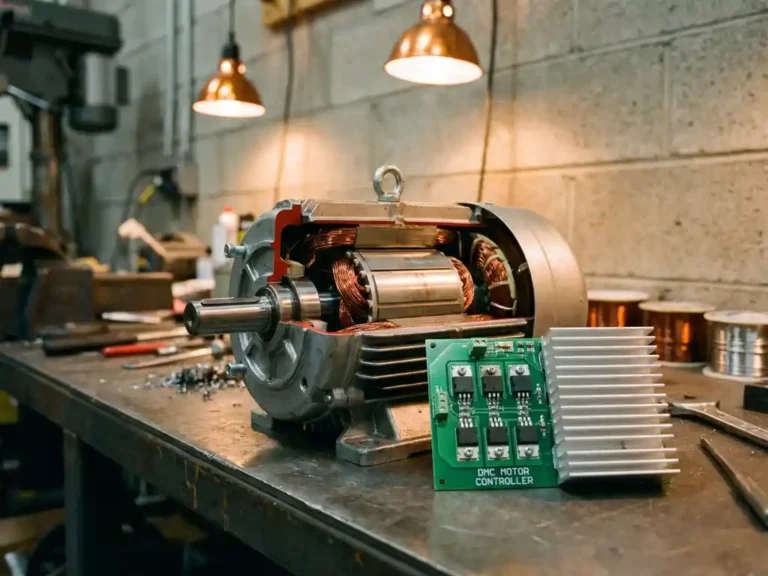
Motor control has come a long way since the days of simple on/off switching and basic voltage regulation. As electric vehicles and industrial machines have grown more demanding, the gap between what older control strategies can deliver and what modern applications actually require has become difficult to ignore. Field oriented control, commonly known as FOC, has emerged as the standard approach for applications where torque response, efficiency, and smooth operation are non-negotiable. Understanding why it outperforms earlier methods requires a look at what those methods were fundamentally unable to do.
FOC applies to both AC induction motors and PMAC motors, making it relevant across a wide range of electric vehicle and industrial platforms. The core principle is elegant: treat the motor’s magnetic field and torque-producing current as independent quantities, control each one separately, and the result is a level of precision that older strategies simply cannot match.
Why older motor control methods fall short
The two most common alternatives to FOC are V/Hz control (also called scalar control) and direct torque control (DTC). Each has its place, but both carry inherent limitations that become apparent under dynamic load conditions.
V/Hz control works by maintaining a fixed ratio between voltage and frequency. It is simple to implement and adequate for applications where the load is predictable and speed precision is not critical. The problem is that it treats the motor as a static system. When the load changes suddenly, the controller cannot respond quickly because it has no direct awareness of the motor’s internal magnetic state. Torque response is sluggish, and at low speeds the approach degrades significantly because the voltage-to-frequency ratio breaks down. For an electric vehicle controller managing traction loads, this kind of delay is a real operational problem.
Direct torque control improves on V/Hz by working directly with torque and flux estimates, but it typically relies on hysteresis-based switching. This produces fast torque response in some conditions, but at the cost of variable switching frequency, which generates acoustic noise and makes thermal management harder to predict. The torque ripple associated with DTC can also be problematic in precision applications.
How FOC decouples flux and torque for precision control
FOC solves the fundamental problem that older methods share: they cannot independently control the two components of stator current that govern flux and torque. In a motor, these are the magnetizing current (which sets up the magnetic field) and the torque-producing current. When they are coupled together, adjusting one inevitably affects the other, which is why response is slow and imprecise.
FOC transforms the motor’s three-phase currents into a rotating reference frame aligned with the rotor flux vector. In this frame, the current naturally separates into two orthogonal components: one controlling flux, one controlling torque. The controller can then regulate each independently using standard PI control loops, applying corrections that are fast, targeted, and stable. The transformation back to three-phase voltages happens in real time, so the motor receives precisely the currents it needs at every instant.
This decoupling is what gives FOC its responsiveness. When a load spike occurs, the torque-producing current component can be adjusted immediately without disturbing the flux level. The motor responds within milliseconds, not hundreds of milliseconds. For applications like forklifts, AGVs, or scissor lifts where load transitions are frequent and sometimes abrupt, this makes a tangible difference in how the machine behaves.
The measurable torque response gains FOC delivers
The practical difference in torque response between FOC and scalar control becomes clear under dynamic conditions. With V/Hz control, the time from a torque demand change to actual torque delivery can stretch to several hundred milliseconds, particularly at low speeds. FOC typically reduces this to single-digit milliseconds, and in well-tuned implementations the response can be even faster.
At zero and near-zero speed, FOC maintains full torque capability. This is one of the most significant advantages for electric vehicle applications, where starting torque under load is a routine demand. Scalar control degrades badly at low frequencies because the voltage-to-frequency relationship no longer holds, and the motor’s resistive losses dominate. FOC does not rely on frequency as a proxy for flux, so it retains control authority all the way to standstill.
Torque ripple is also substantially lower with FOC. Because the current components are regulated continuously in a smooth reference frame rather than through switching hysteresis, the torque output is far more consistent. This reduces mechanical stress on drivetrain components and improves the feel of the vehicle or machine from the operator’s perspective.
FOC performance in sensorless and sensor-based configurations
One practical consideration when implementing FOC is whether to use a physical rotor position sensor or rely on sensorless estimation. Both approaches are viable, and each suits different application requirements.
Sensor-based FOC uses an encoder or resolver to provide accurate, real-time rotor position data. This gives the controller precise flux vector alignment at all speeds, including very low speeds and standstill. The result is the best possible torque response and the most accurate control, which is why sensor-based configurations are preferred in demanding traction applications. The trade-off is the added cost, wiring, and potential failure point of the sensor itself.
Sensorless FOC estimates rotor position from measured voltages and currents using observer algorithms. Modern sensorless implementations have become highly capable, performing well across most of the operating speed range. Performance at very low speeds remains more challenging for sensorless methods, since the back-EMF signals used for estimation are weak at low frequencies. For many industrial and vehicle applications, though, sensorless FOC offers a compelling balance of performance and hardware simplicity. AC motor controllers that support both modes give system designers the flexibility to choose based on the specific demands of their application.
Thermal efficiency as a byproduct of better torque control
Torque response is the headline benefit of FOC, but the thermal implications are equally significant. When a controller delivers torque efficiently, with minimal excess current and low harmonic distortion, less energy is wasted as heat in both the motor and the controller itself.
V/Hz control and DTC both produce higher harmonic content in the motor currents compared to well-implemented FOC. Harmonics cause additional iron losses in the motor and increase resistive heating in the windings. Over time, this thermal load reduces motor lifespan and demands more from the controller’s own cooling system. FOC’s smoother current waveforms reduce these losses, which means the system runs cooler under equivalent load conditions.
For controller hardware, this matters considerably. Power switching devices operate more reliably when junction temperatures stay lower and more predictable. The thermal advantage of FOC is one reason why it pairs well with advanced thermal management approaches in controller design, where keeping switching devices cool directly translates to longer service life and higher reliability in the field.
How DMC supports FOC-based motor control
DMC’s SuperSigma2 and Sigma2N controller ranges are built around FOC as the core control strategy, supporting both AC induction and PMAC motors across nominal battery voltages from 24V to 108V. The controllers are designed to make FOC practical in real applications, not just in theory. Key capabilities include:
- Fully automated motor and sensor tuning, reducing commissioning time and removing the need for manual parameter identification
- Sensorless motor control as a standard option, giving designers flexibility without sacrificing core FOC performance
- Proprietary IMS (Insulated Metal Substrate) technology that mounts power MOSFETs directly onto a metal PCB, providing superior heat sinking that keeps switching devices cooler and extends operational reliability
- Support for single and dual traction, pump, and power-steering motor configurations across AGV, forklift, lift, marine, and industrial platforms
If the torque response and thermal performance of your current motor control setup are limiting your application, it is worth examining whether FOC with the right hardware can close that gap. Contact DMC to discuss your specific requirements and find out which controller configuration fits your system.
Related Articles
- How does machine weight affect traction demand in an electric scissor lift?
- How does steering load change when an industrial vehicle is stationary?
- How does frequent lifting and lowering affect the power demands of a mobile platform?
- AC vs PMS vs IPM vs series controllers: a side-by-side comparison
- How do you choose the right motor for an industrial EV application?