
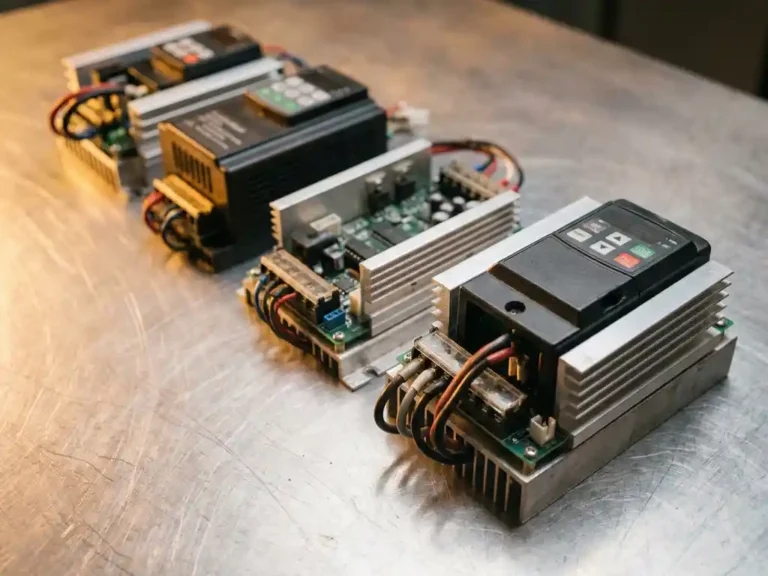
Selecting the right motor controller is one of the most consequential decisions in any electric vehicle or industrial drive project. The controller does not simply switch power on and off; it shapes how the motor delivers torque, how efficiently energy is used, how the vehicle or machine feels to operate, and how costly it is to maintain. This guide compares AC, PMS, IPM and series DC controllers on performance, efficiency, cost and serviceability so you can choose the right one for your electric vehicle or industrial drive. It is written for engineers, technicians, buyers and project leads, from beginners researching the terms to specialists comparing options before a purchase.
What do AC, PMS, IPM and series DC controllers mean?
AC, PMS, IPM and series DC controllers differ in the motor type they drive, how efficiently they convert power, what they cost and how easily they can be serviced. The abbreviations describe the motor technology behind each controller, and knowing them is the first step toward a sound selection.
- AC (induction) controller: drives an AC induction motor using variable frequency control, usually with vector control for precise torque.
- PMS controller: PMS stands for Permanent Magnet Synchronous. It drives PMS motors, which have permanent magnets mounted in the rotor.
- IPM controller: IPM stands for Interior Permanent Magnet. It drives motors whose magnets are embedded inside the rotor, which enables reluctance torque and field weakening.
- Series DC controller: drives a brushed DC motor whose field winding is wired in series with the armature.
“AC PMS” is commonly used to mean an AC-driven permanent magnet synchronous system, so a PMS controller and an AC-driven PMS motor system usually refer to the same thing.
How each controller type handles motor technology
Each motor controller category is defined by the type of motor it is designed to drive, and that relationship shapes the entire control architecture. A series DC motor controller operates on a relatively straightforward principle: it regulates current through a brushed motor where the field and armature windings are connected in series. The control logic is simpler, and the hardware has been mature for decades. The trade-off is mechanical wear at the brushes and commutator, which introduces a maintenance obligation that the other types avoid entirely.
Need a controller for your application?
From traction to pump control, ask us about the right solution for your requirements.
AC induction motor controllers work by generating a rotating magnetic field in the stator, which induces current in the rotor and produces torque without any physical contact between the rotor and stator. The control algorithm, typically field-oriented control (FOC) or vector control, must continuously calculate slip frequency and manage flux, making the electronics more complex but the motor itself robust and low-cost. PMS motor controllers drive motors where permanent magnets are mounted on the rotor surface, providing high torque density and excellent efficiency across a wide speed range. IPM controllers handle motors where those magnets are embedded inside the rotor, allowing additional reluctance torque to be exploited and making the motor better suited to high-speed operation and flux-weakening strategies.
AC vs PMS vs IPM vs series DC controllers: side-by-side comparison
The table below summarises how the four controller types compare on the criteria that matter most in a purchase decision. Ratings are qualitative, because exact figures depend on the supplier, the motor and the application.
| Criterion | AC (induction) | PMS | IPM | Series DC |
|---|---|---|---|---|
| Motor type driven | AC induction motor | Surface-magnet synchronous motor | Interior-magnet synchronous motor | Brushed series DC motor |
| Peak performance and torque | Robust, good overload tolerance | High torque density | High torque plus reluctance torque | Strong low-speed torque |
| Efficiency | Medium to high | Very high | Very high, also at high speed | Low to medium |
| Relative cost | Medium | Higher, magnet-related | Higher, magnet-related | Lowest |
| Serviceability and maintenance | Very low motor maintenance | Low maintenance, skilled service | Low maintenance, skilled service | Brush and commutator upkeep |
| Typical applications | Forklifts, reach trucks, tow tractors | AGVs, golf cars, light carriers | Hybrid vehicles, electric tugs, marine drives | Older forklifts, ground-support equipment |
| Main limitation | More complex control electronics | Weaker at high-speed flux weakening | More sophisticated controller needed | Brush wear and lower efficiency |
Series DC wins on upfront cost and simplicity, while AC induction wins on ruggedness and ease of service. PMS leads on efficiency and compactness, and IPM takes the lead where a wide constant-power speed range and strong high-speed performance are required.
Performance, efficiency, and thermal characteristics compared
When comparing motor controller types on raw performance, the differences become most visible at partial load and at the extremes of the speed range. Series DC controllers deliver strong low-speed torque, which made them the default choice for traction applications for many years. At higher speeds, however, efficiency drops as commutation losses and brush friction become more significant. Thermal management in series DC systems is also constrained by the motor’s own brush gear, which generates heat independently of the controller.
AC induction controllers offer a good balance of efficiency and robustness. Because the motor has no permanent magnets, there is no risk of demagnetisation, and the motor tolerates overload conditions well. PMS controllers, when paired with well-designed surface-mount magnet motors, deliver some of the highest efficiency figures available, particularly at moderate speeds and loads. IPM controllers push this further by enabling flux-weakening at high speeds without the efficiency penalty that surface-mount PMS motors experience in that regime. The controller itself must be more sophisticated to exploit reluctance torque, but the payoff is a wider constant-power operating range. Thermal performance across all three AC/PM types benefits from the absence of brush losses, and with advanced thermal management in the controller hardware, heat dissipation becomes a function of switching losses and conduction losses rather than mechanical friction.
Application fit: which controller suits which vehicle or machine
Matching a controller type to an application comes down to understanding what the duty cycle actually demands. Series DC controllers remain viable in applications where simplicity and low initial cost matter more than peak efficiency, and where motor replacement is straightforward. Older fleets of counterbalance forklifts and some ground-support equipment fall into this category, though the trend toward brushless technology has been steady.
AC induction motor controllers are well established in heavier industrial platforms such as large forklifts, reach trucks, and tow tractors, where motor robustness and the ability to handle aggressive regenerative braking cycles are priorities. The motor can be specified without magnets, keeping material costs predictable regardless of rare-earth price fluctuations. PMS controllers are a strong fit for applications where energy efficiency directly translates to extended shift life or reduced battery size, including AGVs, golf cars, and light personnel carriers. IPM controllers are increasingly chosen for applications that need both high torque at low speed and sustained power at high speed, such as hybrid industrial vehicles, high-performance electric tugs, and marine drives where the operating envelope is wide. Exploring the full range of motor controller options available for these applications is a useful starting point when narrowing down specifications.
Key trade-offs in cost, complexity, and serviceability
Cost comparisons between controller types are rarely straightforward because the controller price is only part of the equation. Series DC systems tend to have the lowest controller cost, but the motor requires periodic brush and commutator servicing, and replacement motors are bulkier for equivalent power. AC induction systems carry a moderate controller cost with very low motor maintenance, making the total cost of ownership competitive over a multi-year service life. PMS and IPM systems often carry a higher motor cost due to permanent magnet materials, though controller complexity is similar to AC induction at the hardware level.
Complexity in commissioning is another dimension worth examining. Series DC controllers are the simplest to set up and require minimal tuning. AC induction controllers need motor parameter identification, but modern controllers automate this process effectively. PMS and IPM controllers require accurate rotor position feedback, either through encoders or resolvers, or through sensorless algorithms that estimate position from back-EMF. Sensorless operation simplifies installation but may have limitations at very low speeds. Serviceability in the field generally favours brushless systems, since there are no wear parts in the motor, and fault diagnosis can be handled through controller diagnostics rather than physical inspection of commutation hardware.
Cost and serviceability: what to expect over the lifetime
Looking at lifetime cost means separating four things: upfront cost, running efficiency savings, maintenance needs, and repair or replacement considerations. Exact figures depend on the supplier and the application, so the points below are qualitative guidance rather than price promises.
Series DC systems have the lowest entry cost, but brush and commutator maintenance recurs throughout the life of the machine. Each service interval means downtime, and lower efficiency can add to energy use and battery load. AC induction systems are robust and easy to service, and because the motor contains no magnets, there is no magnet-related cost or exposure to rare-earth price swings.
PMS and IPM systems have a higher initial cost and usually call for skilled service. Their efficiency gains can reduce energy consumption and, in some designs, allow a smaller battery, which can offset the higher purchase price over time. The more a machine runs, the more these savings tend to matter.
Beyond the drive type itself, three practical factors shape the real cost of ownership: spare part availability, diagnostic complexity and the operating environment. A controller with good built-in diagnostics shortens fault finding, while dust, moisture, heat and vibration all influence service intervals and component life. Local maintenance skills matter too, since a technically superior system loses its advantage if nobody nearby can service it.
- Upfront cost: lowest for series DC, moderate for AC induction, higher for PMS and IPM.
- Running efficiency savings: greatest with PMS and IPM, solid with AC induction, limited with series DC.
- Maintenance needs: highest for series DC because of brushes, very low for AC induction, low for PMS and IPM.
- Repair or replacement: simple and cheap for series DC parts, robust and straightforward for AC induction, more specialised for PMS and IPM.
Choosing the right controller for your application
The decision rarely reduces to a single metric. A useful approach is to start with the duty cycle: how much time does the machine spend at low speed versus high speed, at full load versus partial load, and how frequently does it regenerate? Applications with long periods of moderate load and speed, such as AGVs following fixed routes, benefit most from PMS efficiency. Applications with highly variable loads and frequent overload events lean toward AC induction for its thermal resilience. Where the speed range is wide and constant power across that range matters, IPM is worth the added commissioning effort.
Budget constraints and existing motor inventory also shape the decision. If a fleet already uses AC induction motors, replacing only the controllers to gain modern vector control is often more economical than re-motoring. If a new platform is being designed from scratch, the choice of motor and controller can be optimised together, and the efficiency gains from a well-matched PMS or IPM system can justify the higher component cost through reduced energy consumption over the machine’s lifetime. Consulting with a specialist early in the design process, before motor and gearbox selections are finalised, avoids the more costly adjustments that come from retrofitting a controller to a motor it was not sized for.
How to choose the right controller for your application
Work through the five steps below in order. Each step points toward one or more controller types, and the final choice is the one that fits most of them.
- Define the application and duty cycle. A road EV, low-speed utility vehicle, forklift, pump or fan, and conveyor all load a controller differently. Frequent overloads and heavy regeneration favour AC induction, while steady moderate loads favour PMS.
- Set the efficiency and range priority. If battery size, shift length or range is critical, PMS and IPM are favoured because they waste the least energy. If efficiency is secondary, AC induction or series DC remain reasonable.
- Set the budget and acceptable lifetime cost. A tight upfront budget leans toward series DC, but a long service life with high running hours often favours AC induction or PMS once maintenance and energy costs are counted.
- Assess serviceability needs and local maintenance skills. Where technicians are used to simple, robust equipment, AC induction is the safest choice. Where skilled support is available, PMS and IPM become practical.
- Check power, speed range and space constraints. A wide constant-power speed range points to IPM, while tight packaging and high power density point to PMS.
These pairings summarise how priorities translate into a choice:
- If your priority is the lowest upfront cost, choose series DC.
- If your priority is rugged, serviceable industrial duty, choose AC induction.
- If your priority is maximum efficiency and compactness, choose PMS.
- If your priority is a wide speed range and high-speed performance, choose IPM.
Typical pairings for electric vehicles and industrial drives follow the same logic: a light personnel carrier or AGV suits a PMS controller, a heavy reach truck suits AC induction, a hybrid industrial vehicle or marine drive suits IPM, and a basic older forklift retrofit can still make sense with series DC.
How DMC helps with motor controller selection
DMC (Digital Motor Control) GmbH designs and manufactures the SuperSigma2 range of motor speed controllers, covering AC induction, PMS, and IPM motor types on nominal battery voltages from 24V to 108V, with nominal powers up to 30kW and peak powers up to 60kW. The range is built around DMC’s proprietary IMS (Insulated Metal Substrate) technology, which mounts power switching devices directly onto a metal PCB for superior heat dissipation without bulky external heatsinks. For engineers working through the AC vs PMS vs IPM vs series controllers decision, the SuperSigma2 platform offers several concrete advantages:
- Fully automated motor and sensor tuning, reducing commissioning time across AC induction, PMS, and IPM motor types
- Sensorless motor control available as an alternative to encoder or resolver feedback, simplifying installation in space-constrained applications
- Support for single and dual traction configurations, pump motors, and power-steering motors within a single controller family
- Custom solutions available for applications that fall outside standard specifications, backed by a team with deep experience in AGVs, forklifts, stackers, boom lifts, marine drives, and hybrid industrial platforms
- DC/DC converters up to 4kW available alongside the controller range to complete the power electronics package
If you are evaluating controller options for a new platform or a fleet upgrade, contact the DMC team to discuss your motor type, voltage, power requirements, and duty cycle. Early involvement in the specification process consistently produces better outcomes than selecting a controller after the motor and mechanical design are already fixed.
Which controller should you choose?
- Choose an AC induction controller if you need a robust, easily serviced drive for heavy industrial duty with frequent overloads and regeneration.
- Choose a PMS controller if you need the highest efficiency and compact size for steady, moderate-load applications such as AGVs and golf cars.
- Choose an IPM controller if you need strong torque at low speed and sustained power across a wide speed range.
- Choose a series DC controller if you need the lowest upfront cost and can accept regular brush and commutator maintenance.
Not sure which controller fits your electric vehicle or industrial drive? Contact the DMC team with your voltage, power and duty-cycle requirements and we will help you select the right option.