
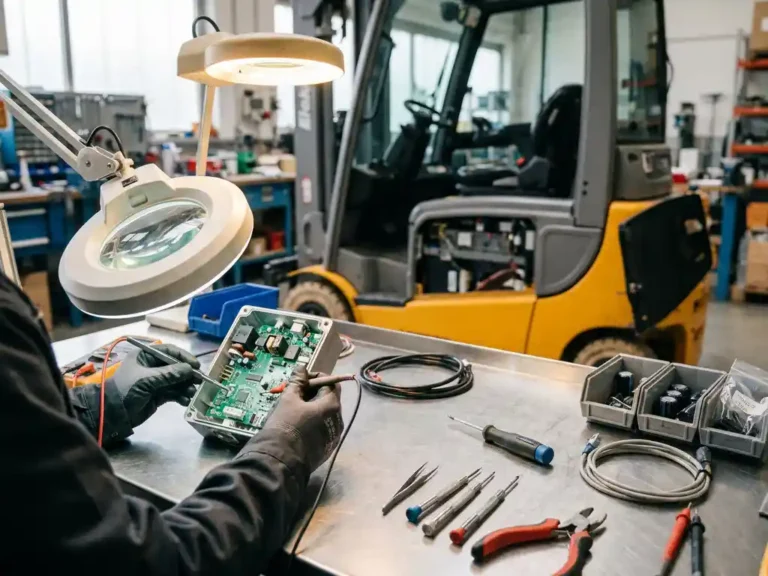
When a motor controller fails in the field, the cost is rarely just the component itself. Downtime, delayed operations, and the scramble to find technical guidance can quickly outweigh the price of the hardware. For operators running electric vehicles in demanding environments, aftermarket support is not a secondary consideration — it is part of what makes a controller investment viable over the long term.
The term aftermarket support covers a broad range of services that manufacturers provide after the point of sale. In the context of electric vehicle controllers, this support structure directly affects how quickly problems get resolved, how well equipment performs across its service life, and whether operators can maintain uptime in applications where interruptions carry real operational costs.
What aftermarket support actually covers for motor controllers
Aftermarket support for motor controllers goes well beyond warranty replacement. At its core, it includes technical documentation, fault diagnostics, firmware updates, spare parts availability, and direct access to engineers who understand the product at a design level. For controllers managing traction, pump, or power-steering motors, the scope of support needs to match the complexity of what the controller is doing.
Good after-sales support also includes configuration assistance. Controllers used in forklift, stacker, or AGV applications often require parameter tuning specific to the vehicle’s load profile, motor type, and operating environment. When something changes — a motor replacement, a battery voltage shift, or a new duty cycle — support teams that can guide operators through reconfiguration save significant time compared to trial-and-error adjustments in the field.
Spare parts logistics matter too. A controller that is no longer supported with replacement components becomes a liability after a few years in service. Manufacturers with long-term parts availability commitments give fleet operators a much clearer picture of total cost of ownership, which affects purchasing decisions well before a fault ever occurs.
How strong support reduces downtime in electric vehicle applications
In electric vehicle applications, downtime is rarely abstract. A grounded forklift in a warehouse, a scissor lift that cannot be deployed on a job site, or an AGV that drops out of a production line all carry measurable costs per hour. Controller maintenance support that is fast, technically accurate, and accessible by phone or email directly shortens the window between fault detection and resolution.
Remote diagnostics capabilities have become an important part of this equation. Controllers that log fault codes and operational data allow support teams to assess a problem without requiring a site visit. When a technician can review logged data and identify whether a fault is thermal, electrical, or configuration-related, the path to a fix becomes much shorter. This kind of remote troubleshooting capacity depends on both the hardware design and the support team’s familiarity with the product.
Operators who work with manufacturers offering direct engineering access — rather than routing queries through generic call centres — tend to resolve issues faster. The difference is particularly clear with complex faults that do not match standard error codes, where product-specific knowledge is the only reliable resource.
The link between controller complexity and support requirements
Modern AC induction and PMAC motor controllers operate with sophisticated control algorithms, automated tuning routines, and sensor fusion that would have been considered advanced, research-grade technology not long ago. That complexity delivers real performance benefits, but it also means that diagnosing and correcting problems requires a deeper level of knowledge than older, simpler DC controllers demanded.
Controllers with automated motor and sensor tuning, for example, simplify initial commissioning considerably. However, when a tuning result produces unexpected behaviour, understanding why requires familiarity with how the tuning algorithm interacts with specific motor characteristics. Support teams that were involved in the product’s development are better positioned to answer those questions than third-party service providers working from a manual.
Sensorless motor control adds another layer of complexity. Operating without hall-effect or encoder feedback means the controller is estimating rotor position through electrical measurements, and the conditions under which that estimation can drift or fail are not always obvious. Reliable motor controller support in these cases means having access to people who understand the control strategy, not just the wiring diagram.
What to look for in a motor controller manufacturer’s support offering
When evaluating a manufacturer’s after-sales support, the quality of documentation is a useful early indicator. Clear, complete technical manuals, application notes, and commissioning guides suggest a manufacturer that invests in making its products usable beyond the sale. Sparse or poorly translated documentation often signals that support will be similarly thin when it is needed most.
Response time commitments and support channel availability are worth examining directly. Some manufacturers offer dedicated technical support lines staffed by engineers; others route queries through sales teams or distributors with limited product knowledge. For applications running multiple shifts or operating in remote locations, knowing how quickly a qualified response can be expected matters.
- Availability of firmware updates and whether they are provided free of charge
- Clarity on spare parts availability and how long components will remain in production
- Whether configuration tools and diagnostic software are accessible to operators or locked to service centres
- Access to engineering-level support for non-standard or custom applications
Custom application support is particularly relevant for operators using controllers in non-standard configurations. Manufacturers that offer flexibility in controller design and are willing to work through application-specific requirements during the sales process tend to carry that same orientation into their support operations.
How DMC helps with motor controller aftermarket support
DMC (Digital Motor Control) GmbH provides aftermarket support as an integrated part of its controller offering, backed by a team with direct design and manufacturing experience across the full SuperSigma2 and Sigma2N product ranges. For operators running electric vehicles in demanding industrial environments, that depth of knowledge translates into faster, more accurate support when it counts.
- Direct access to engineers familiar with DMC’s proprietary IMS technology and controller architecture
- Technical support covering commissioning, fault diagnostics, parameter configuration, and motor tuning
- Aftermarket parts availability and long-term product support commitment
- Support for custom and non-standard applications across AGVs, forklifts, stackers, boom lifts, and marine platforms
- Guidance on sensorless operation, dual traction setups, and pump or power-steering motor configurations
If you are evaluating DMC’s product range or need support for an existing installation, get in touch with the DMC team directly to discuss your application requirements.
Related Articles
- What happens to a scissor lift electrical system while the platform is being raised?
- How does a changing payload affect an electric drivetrain?
- Is IPM the same as PMSM? Here's the real difference
- What makes an FOC motor controller different from a standard PWM controller?
- What is the difference between a motor controller and a motor inverter?