
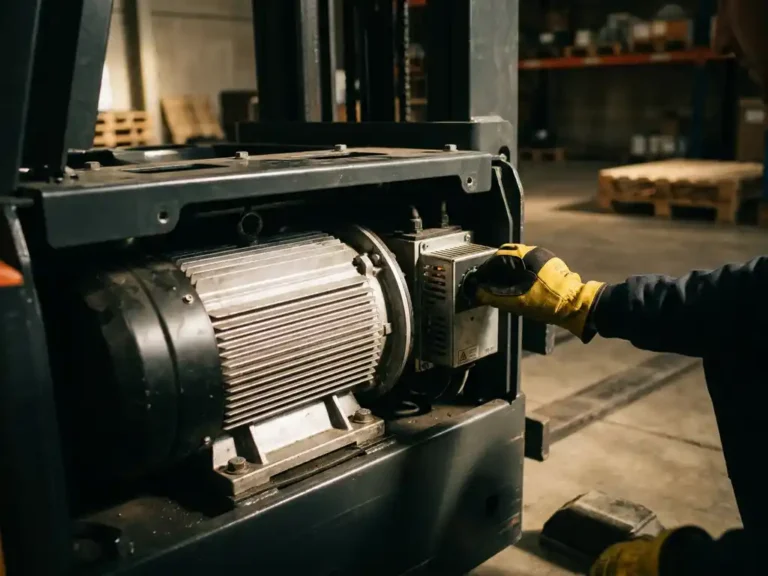
Field weakening is one of those motor control techniques that rarely comes up during routine commissioning, but becomes essential the moment an application demands more speed than the motor’s rated design allows. For field service engineers working with battery-driven electric vehicles and industrial platforms, understanding when and how to apply it can be the difference between a system that meets specification and one that falls short under real operating conditions. The motor controller plays a central role in how field weakening is implemented and managed, which makes it worth examining in practical terms.
How field weakening extends motor speed beyond base speed
Every AC induction or permanent magnet motor has a base speed, the point at which the controller is delivering maximum voltage to the motor at the rated frequency. Below this speed, the controller can increase torque by raising current. Above it, the supply voltage has reached its ceiling, and the motor cannot accelerate further through conventional means.
Field weakening works by intentionally reducing the magnetic flux inside the motor. In an AC induction motor, this is achieved by reducing the magnetising current component. In a permanent magnet motor (PMS or IPM), the controller injects a negative d-axis current to partially oppose the rotor’s fixed flux. Either way, the result is that the motor can spin faster than its base speed because the back-EMF, which would otherwise limit speed, is kept in check. The trade-off, as discussed below, is a reduction in available torque.
When field weakening becomes necessary in real applications
Field weakening is not a feature that every installation needs, but certain applications make it almost unavoidable. The clearest case is a vehicle or machine that must operate across a wide speed range without changing the battery voltage or the motor itself.
Forklifts and reach trucks often need a burst of travel speed on flat surfaces while still delivering high torque at low speed for lifting. Golf cars and AGVs face similar demands, where top-end speed on open paths matters as much as controlled low-speed manoeuvring in confined areas. Boom lifts and scissor lifts sometimes require the traction motor to run faster than the base speed to meet drive-away requirements after a lift cycle. In each case, field weakening allows the same motor and battery combination to cover a broader operating envelope without hardware changes.
Trade-offs between speed gain and torque reduction
Gaining speed through field weakening always comes at the cost of torque capacity. The relationship is not linear, and the extent of the reduction depends on how far into the field weakening region the motor is operating.
At moderate field weakening depths, the torque reduction is manageable and the efficiency loss is relatively small. Push further, and available torque drops sharply while the motor and controller work harder to maintain stability. For permanent magnet motors, deep field weakening also carries a risk specific to IPM and PMS designs: if the controller loses control of the d-axis current at high speed, the resulting flux can generate a voltage spike that exceeds the DC bus rating. This is not a theoretical concern. It is a real failure mode that engineers need to account for when setting field weakening limits, particularly on battery systems where the bus voltage can vary with state of charge.
Thermal loading also shifts during field weakening operation. The additional current required to suppress flux adds to the losses in both the motor windings and the controller’s power stage. Applications that spend extended periods in the field weakening region benefit from controllers with robust thermal management, since heat build-up at this operating point is more sustained than during short peak torque events.
Configuring field weakening on the SuperSigma2 controller
The SuperSigma2 motor controllers from DMC support field weakening across all three motor types in the range: AC induction, PMS, and IPM. Because the control architecture handles each motor type differently, the configuration process varies depending on which motor is connected.
For AC induction motors, the controller manages field weakening by adjusting the flux-producing current component relative to the speed reference. The autotuning process that runs during initial commissioning establishes the motor’s electrical parameters, and the field weakening behaviour is derived from those values. Engineers can adjust the onset speed and the rate of flux reduction through the parameter set, giving flexibility to match the motor’s characteristics to the application’s speed-torque requirements.
For PMS and IPM motors, the d-axis current injection required for field weakening is managed through the same vector control framework. The autotuning routine identifies the motor’s inductance values, which directly influence how the controller calculates the required d-axis current at any given speed. Getting these parameters right during commissioning is what determines whether field weakening behaves predictably or causes instability at the top of the speed range.
Common commissioning errors that affect field weakening performance
Most field weakening problems trace back to commissioning, not to faults in the controller or motor. The autotuning process is thorough, but it depends on the motor being in a representative state when the routine runs.
Running autotuning with the motor disconnected from the drivetrain is one of the more common mistakes. Mechanical load affects how the motor responds during the identification phase, and parameters derived from a free-spinning motor may not reflect real operating conditions accurately enough for stable field weakening at speed. Similarly, running autotuning at a battery state of charge that is significantly different from normal operating conditions can skew the voltage-related parameters that influence where field weakening begins.
For permanent magnet motors, incorrect inductance values are the most direct cause of instability in the field weakening region. If the d-axis inductance is underestimated, the controller will apply insufficient negative flux current at high speed, and the motor will struggle to stay within the voltage limit. If it is overestimated, the torque available in the field weakening region will be lower than expected, and the motor may behave sluggishly at the top end of the speed range. Re-running autotuning after any motor replacement or significant wiring change is not optional, it is the correct procedure.
Speed sensor integrity also matters more in the field weakening region than at lower speeds. A speed signal with noise or dropout events causes the controller to make rapid corrections to the flux level, which can produce audible instability or trigger protective shutdowns. Checking encoder wiring and shielding before investigating controller parameters is always the right first step when field weakening behaviour becomes erratic after installation.
How the SuperSigma2 supports field weakening across motor types
DMC’s SuperSigma2 range is designed to handle field weakening as a standard capability rather than an optional add-on. Several features of the platform are directly relevant to how well field weakening performs in practice:
- Fully automated motor and sensor tuning establishes the electrical parameters that field weakening depends on, reducing the margin for manual configuration errors.
- Support for AC induction, PMS, and IPM motors in a single controller platform means the same hardware can be deployed across applications with different motor technologies, each with its own field weakening characteristics.
- The IMS (Insulated Metal Substrate) thermal architecture keeps the power switching devices cooler during the sustained high-current conditions that field weakening operation produces, which directly supports reliability in applications that spend significant time above base speed.
- The dual-processor architecture introduced in 2023, combined with CANopen connectivity, gives engineers the ability to monitor operating parameters in real time and adjust field weakening settings without physical access to the controller.
If an application requires field weakening and the configuration is not producing the expected results, the DMC technical team can assist with parameter review and commissioning support. Contact DMC to discuss the specific requirements of the installation.