
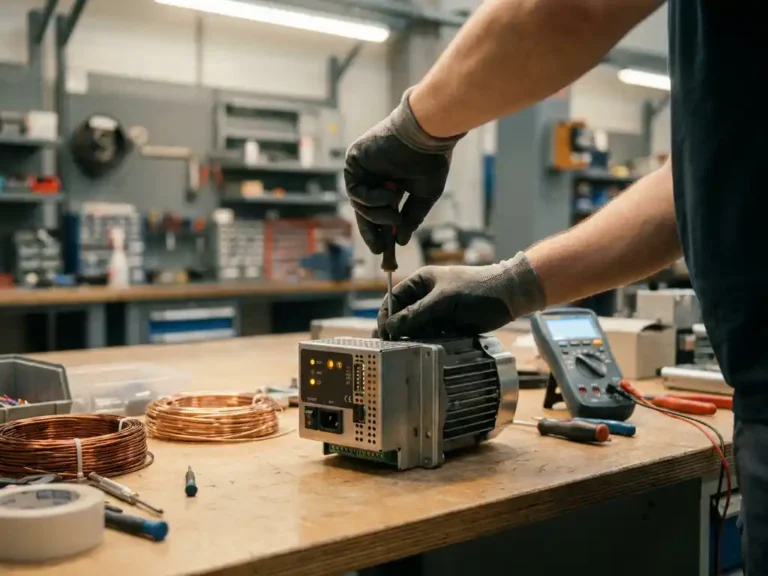
Autotuning is one of those features that sounds straightforward until you’re standing in front of a machine that won’t run correctly and trying to figure out why the motor controller isn’t behaving as expected. At its core, autotuning is an automated calibration process built into a motor controller that measures the electrical characteristics of a connected motor and calculates the control parameters needed to drive it correctly. For field service engineers working with AC induction, PMS, or IPM motors across a range of battery voltages and load conditions, understanding what autotuning does and where its limits lie is genuinely useful knowledge.
Manual tuning vs. autotuning: the core difference
Traditional motor controller commissioning required an engineer to manually enter motor parameters, either sourced from a datasheet or measured with separate test equipment. This meant inputting values like stator resistance, leakage inductance, and rotor time constant before the controller could begin operating the motor at all. Getting these values wrong, even slightly, could produce poor torque response, thermal stress on the motor, or instability under load.
Autotuning removes this dependency on external data. Instead of relying on the installer to supply correct parameters, the controller applies controlled test signals to the motor while it is stationary or running at low speed, then measures the electrical response directly. The result is a set of motor parameters derived from the actual connected motor rather than from documentation that may be incomplete, outdated, or simply unavailable for older or remanufactured units.
What autotuning actually measures and calculates
During an autotuning sequence, the controller injects known voltage signals and observes the resulting current waveforms. From this, it can extract the motor’s DC resistance, stator inductance, and, in the case of AC induction motors, the rotor resistance and magnetising inductance. These values define how the motor behaves electrically and directly inform how the controller’s vector control algorithm should apply torque and flux commands.
For permanent magnet motors (PMS and IPM types), the process also identifies back-EMF characteristics and, where sensors are present, verifies the alignment of the encoder or resolver relative to the rotor’s magnetic position. Sensor offset is a particularly important measurement because even a small angular error between the sensor and the actual rotor position will degrade torque accuracy and efficiency across the entire operating range.
How autotuning works in the SuperSigma2 controller
The SuperSigma2 motor controller implements fully automated motor and sensor tuning as a standard feature across the entire range. When autotuning is initiated, the controller runs a structured sequence of test routines that cover both motor characterisation and, where applicable, sensor calibration. The engineer does not need to enter motor nameplate data or perform separate offset measurements with external tools.
The controller supports AC induction, PMS, and IPM motors within a single platform, which means the autotuning routine is designed to handle the different electrical behaviours of each motor type without requiring the installer to select a specific measurement mode. Operating across nominal battery voltages from 24V to 108V and nominal powers up to 30 kW, the controller applies test signals that are scaled appropriately to the connected system. Sensorless control is available within the SuperSigma2 architecture, though DMC does not deploy it for traction applications, where sensor-based feedback remains the standard approach for reliable torque control at low speed.
Benefits for commissioning and field service workflows
The practical impact of autotuning on commissioning time is significant. A process that previously required careful manual parameter entry, followed by iterative testing and adjustment, becomes a single guided procedure. For engineers commissioning multiple units in a production environment or servicing machines in the field without access to original motor documentation, this reduces both time on site and the risk of errors introduced during data entry.
There are also benefits when motors are replaced in service. If a motor is swapped due to failure, the replacement unit may not be identical to the original, even if it carries the same nameplate rating. Running autotuning after a motor replacement ensures the controller is calibrated to the actual installed motor rather than retaining parameters from a previous unit that may have had slightly different characteristics. This matters most in applications where precise torque control affects safety or productivity, such as forklifts, stackers, and aerial work platforms.
When autotuning results need verification
Autotuning produces reliable results under normal conditions, but there are situations where the output should be checked rather than accepted without review. Motors with significant winding damage or insulation degradation may produce measurements that appear valid but reflect an abnormal electrical state. Running autotuning on a motor with a developing fault can mask the problem rather than surface it.
Environmental factors also matter. Very low ambient temperatures affect winding resistance, which means autotuning performed in a cold warehouse may produce resistance values that differ from those the motor exhibits at operating temperature. In high-precision applications, it is worth noting the conditions under which autotuning was run and repeating the process if the machine will be operating in substantially different thermal conditions.
Sensor tuning results deserve particular attention on motors where the encoder or resolver has been physically repositioned or replaced. If the sensor mounting has any mechanical play, the autotuned offset may shift slightly over time as the sensor settles. A follow-up check after the first few hours of operation is a reasonable precaution in these cases.
How the SuperSigma2 supports motor controller commissioning
For engineers who commission and service battery-driven electric vehicles and industrial platforms, the SuperSigma2 range is built around the kind of automated calibration workflow described in this article. Key capabilities relevant to commissioning include:
- Fully automated motor tuning that works across AC induction, PMS, and IPM motor types without requiring separate configuration
- Integrated sensor tuning that calculates encoder or resolver offset directly, removing the need for manual alignment procedures
- Support for dual traction, pump, and power-steering motor applications within a single controller platform
- CANopen communication (standard since early 2023) for integration with vehicle control systems and diagnostic tooling
- A nominal power range up to 30 kW and peak up to 60 kW, covering a broad range of industrial vehicle applications
If you are evaluating the SuperSigma2 for a specific application or have questions about how its autotuning process applies to your motor type or system configuration, contact the DMC team directly for technical guidance.