
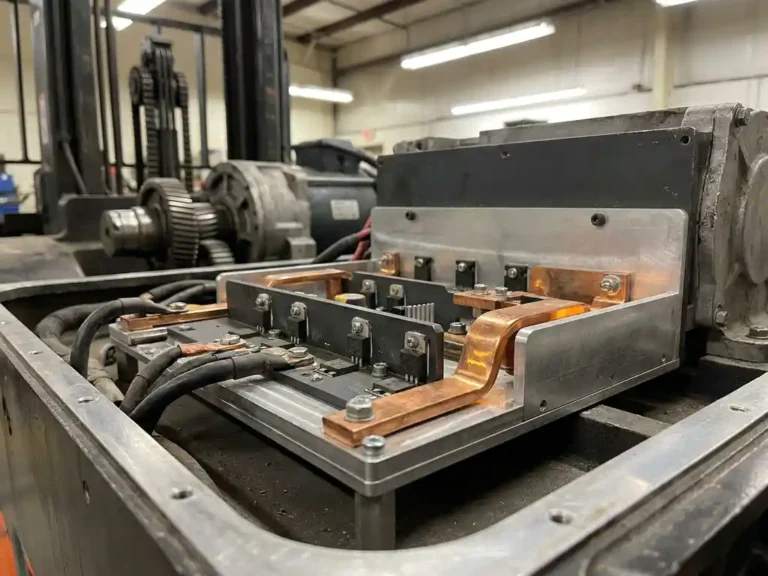
The term “motor controller” covers a wide range of devices, from simple speed regulators on conveyor systems to sophisticated traction controllers managing the drive dynamics of electric forklifts and automated guided vehicles. Grouping them all under the same label makes sense at a basic level, since they all regulate electrical power to a motor. But when a field service engineer specifies a controller for a battery-driven vehicle, the differences between a traction-grade unit and a general-purpose motor controller become immediately relevant.
Traction controllers are not simply more powerful versions of general controllers. They are built around a fundamentally different set of operating assumptions, where vehicle dynamics, battery management, regenerative braking, and thermal stress under variable load all shape the architecture from the ground up.
Core design priorities that set traction controllers apart
A general-purpose motor controller is typically designed around a predictable load profile. A pump runs at a set speed, a conveyor maintains a defined torque, and the operating conditions stay relatively stable. The controller only needs to handle that steady-state demand efficiently.
Traction applications work differently. Acceleration from standstill, load-dependent climbing, regenerative braking, and sudden directional changes all create highly variable current demands within short time windows. A traction controller must respond to these transients accurately while protecting the battery, managing heat, and maintaining safe vehicle behaviour. This means the control algorithms, current sensing, and protection logic are substantially more complex than in a general-purpose design.
How traction controllers handle motor compatibility
General motor controllers are usually built for a single motor type, whether that is a brushed DC motor, an AC induction motor, or a permanent magnet synchronous motor. Swapping motor types typically means replacing the controller entirely.
Traction controllers designed for modern electric vehicles often need to support multiple motor technologies within the same platform, since vehicle manufacturers may use different motor types across their product lines or switch suppliers between production runs. Advanced traction controllers address this through automatic motor identification and tuning routines that characterise the connected motor and configure the control parameters accordingly. This flexibility reduces the number of controller variants a service engineer needs to stock and simplifies commissioning across different vehicle models. When reviewing motor controllers for a mixed fleet, this kind of multi-motor compatibility is worth evaluating carefully.
Thermal management and power device architecture
Heat is one of the primary failure mechanisms in any power electronics system, and traction applications generate heat in a particularly demanding pattern. Short bursts of very high current during acceleration or hill climbing alternate with periods of lighter load, creating thermal cycling that stresses both the power devices and their mounting structures.
General controllers often rely on conventional PCB layouts where power devices are mounted on standard FR4 substrate and cooled by an external heatsink attached to the case. This works well for steady-state loads but can struggle with the thermal transients common in traction. Traction-grade controllers increasingly use metal substrate PCB technology, where the power switching devices mount directly onto a metal base layer that conducts heat away far more efficiently than standard PCB material. This approach reduces the thermal resistance between the device junction and the heatsink, keeping transistor temperatures lower during peak current events and extending component life over the operational lifetime of the vehicle.
Application-specific features general controllers lack
Beyond the core control architecture, traction controllers incorporate a range of features that simply do not appear in general-purpose designs because the application does not require them.
Regenerative braking is one example. In a traction application, recovering kinetic energy during deceleration and returning it to the battery extends range and reduces wear on mechanical brakes. Implementing this correctly requires the controller to manage bidirectional power flow and monitor battery state to avoid overcharging, which adds significant complexity to the control software and hardware design.
Vehicle-level safety functions are another category. Traction controllers typically include features such as controlled speed limiting based on load or terrain signals, smooth start and stop profiles to prevent tip-over in lifted vehicles, and integration with vehicle safety systems through industrial communication protocols. CAN bus connectivity, for instance, allows the controller to exchange data with battery management systems, display units, and fleet management software in real time. A general motor controller driving an industrial fan or pump has no need for any of this.
Choosing the right controller for your application
The practical question for a field service engineer or system integrator is whether the application genuinely requires a traction controller or whether a general-purpose unit will perform adequately. The answer depends on a few concrete factors.
If the motor load is predictable and continuous, a general controller is often sufficient and more cost-effective. If the application involves a vehicle that accelerates, decelerates, changes direction, or operates on inclines with varying loads, the dynamic range and protective features of a traction controller become necessary rather than optional. Battery voltage range also matters: traction controllers are designed to operate across the full discharge curve of a battery pack, maintaining stable performance as voltage drops during a shift, whereas general controllers may be rated for a fixed supply voltage with little tolerance for variation.
Sensor integration is worth considering as well. Traction controllers typically support encoder and resolver feedback for precise speed and position control, along with sensorless modes for situations where sensor installation is impractical. General controllers may offer only basic feedback options.
How the SuperSigma2 addresses traction controller requirements
DMC’s SuperSigma2 range was developed specifically to meet the demands described throughout this article. It is built around the real-world requirements of battery-driven vehicles and industrial traction platforms, not adapted from a general-purpose design.
- Supports AC induction, PMS, and IPM motor types within a single controller platform, with fully automated motor and sensor tuning at commissioning
- Operates across a nominal battery voltage range of 24V to 108V, covering the discharge curve of most industrial battery packs
- Delivers nominal power up to 30 kW and peak power up to 60 kW, with the thermal headroom to handle traction transients reliably
- Uses DMC’s proprietary IMS (Insulated Metal Substrate) technology to mount power devices directly onto a metal PCB, reducing thermal resistance and keeping switching devices cooler under variable load
- Includes dual-processor architecture and full CANopen connectivity for integration with vehicle systems, battery management, and fleet software
- Sensorless control is available but deliberately not used for traction, where encoder or resolver feedback provides the precision that vehicle dynamics require
For engineers specifying or commissioning a controller for a forklift, AGV, stacker, or similar platform, the SuperSigma2 is worth evaluating against the criteria above. To discuss your specific application or request technical documentation, contact the DMC team directly.
Related Articles
- How does an electric pump react when a hydraulic function reaches its pressure limit?
- How does vehicle weight influence electric steering demand?
- What happens to an electric steering system during rapid direction changes?
- Is IPM the same as PMSM? Here's the real difference
- AC vs PMS vs IPM vs series controllers: a side-by-side comparison